Preparing for summer 2026
Get ready for the world’s biggest soccer stage

Introduction
Millions of fans. Three countries. One massive opportunity.
In 1994, the United States hosted what was then the largest World Cup finals tournament on record, with total and average attendances that still stand as benchmarks today. Stadiums filled, records fell, and a new generation of fans embraced a sport that had long taken a back seat to baseball and NFL football. This summer, that stage returns to North America—bigger, louder, and more connected than ever.
The scale of what’s coming is best understood in numbers. The tournament has expanded from 32 to 48 teams and from 64 to 104 games, and it will be staged across three countries for the first time. In just 33 days, fans submitted more than 500 million ticket requests for 2026, with applications from all 211 FIFA member associations and the three host nations among the top applicant countries. Qatar’s edition saw around 5 billion people engage with World Cup content globally, confirming it as the biggest single sporting event on the planet. This return to North America brings more matches, more host cities, and higher expectations from traveling fans than ever before.
For businesses across the host countries, the games don’t start and stop at the stadiums. As fans converge on host cities, their expectations also cross borders: they look for instant, reliable payments, smooth movement between cities, and experiences that feel both local and globally connected. Adyen processes payments for many of the world’s leading brands, including those closely involved in tournament‑related activity, giving clear visibility into how major cultural moments translate into real‑time shifts in spending. Drawing on those insights, this playbook outlines what is likely to happen as millions of fans move through the streets, stores, and stadiums of North America—and how businesses can prepare.
Retail

When the soccer fans arrive, so do the big spenders
Major sporting events don’t just bring crowds, they attract high-value travelers. Given the costs of travel, tickets, and accommodation, most visiting fans fall into the premium-spending bracket, transforming downtown areas into high-activity retail zones.
During the summer games in Paris in 2024, spend on and around major events rose sharply across the platform. As we look ahead to what is likely to be the largest sports event in history this summer, we’re preparing for a similar surge from both domestic and international fans.
To understand the role of international shoppers in North America, we analyzed platform data from the summer of 2025 in the US. This shows that non‑domestic shoppers account for a significant share of retail spend, particularly in categories like clothing and jewelry. While local shoppers spend an average of $110.90 per apparel transaction, international visitors spend $186.52 – around 70% more per purchase.
European visitors account for 38% of international transactions, but tourists from Asia, particularly China, Japan, and South Korea, stand out as “super‑spenders.” Their average retail transaction is $306.40, nearly $188 higher than their European counterparts ($118.50). Among these, 1 in 10 purchases by Japanese tourists in luxury stores exceeds $442.70. Asian teams were among the first to qualify, giving them the longest runway to plan trips to North America: South Korea opens in Guadalajara, Mexico (June 12), Japan in Dallas (June 14).
Visitors from Latin America, notably Brazil, Argentina, and Colombia, also outspend the European average, with an average transaction value (ATV) of $157.47. Together, these insights highlight that hosting a major sporting event drives not only higher overall spend, but a distinct international premium segment focused on luxury and high‑margin retail categories.
During the summer games in 2024. This is most evident in the jewelry sector, where tourists spend an average of $1.7k, nearly double the local average of $888.80. Among jewelry shoppers, Chinese (ATV $4.5k) and Japanese (ATV $3.9k) accounted for 14% of non-domestic transactions each.
In the majority of instances, non-domestic shoppers prefer traditional card payment methods such as Visa, Mastercard, and American Express. However, data from summer 2025 indicates that specialized payment networks like China UnionPay (CUP) and the Japan Credit Bureau (JCB) command much higher ATVs of $492.20, compared to the $165.20 seen on standard cards. If a terminal cannot process these specific schemes and contactless methods instantly, businesses stand to lose out on a big spend opportunity.
Let your terminal work the sale
High-value international shoppers expect frictionless checkout—especially when baskets hit $1,000–$5,000. Payment infrastructure that unifies global cards, currencies, and authorization rules captures revenue rigid systems miss.
Foreign visitors will drive ~1/3 of event retail traffic, a segment Deloitte flags as central to Mexico's tournament economy. Their data also shows hosting value exploding +300% from the 2002 tournament to 2022 while noting the effect the tournament has on ancillary industries.
To capture this opportunity: tokenization cuts repeat declines, premium card routing boosts approvals, and customer recognition IDs high-spenders across borders.

What retailers must get right
Use Dynamic Currency Conversion (DCC) to turn browsers into buyers. Offer home-currency options quickly without delaying staff.
Be globally ready at the counter. Make it easy for global visitors to spend with your business by accepting their favorite ways to pay. Select your setup method below:
Automate your payment method settings at scale using our Management API.
Switch on new payment methods instantly via your Customer Area dashboard.
Alternatively, set up a meeting with your account manager to discuss the perfect payment mix for this summer.
Travel and mobility

Mobility demand follows the bracket, not the calendar
Major tournaments don’t just fill stadiums, they reshape transport patterns across entire regions. Airlines, rideshare services, rail operators, and mobility platforms see demand spike and then shift rapidly as fixtures change, teams advance, and fans adjust plans at short notice. This volatility drives a 40% increase in flexible or changeable bookings as travelers wait to see who advances before locking in their next move.
The data points to a clear prize, the premium tourist. While traditional cards make up most transactions, regional schemes such as Alipay+, CUP, JCB, and WeChat Pay are tied to an average order value of around $535.90. These journeys are highly concentrated by origin, with travelers from China responsible for the vast majority of CUP spend and Japanese fans accounting for most JCB volume. Visitors from the Americas, particularly Brazil, Argentina, and Colombia, also stand out, with an average transaction value of $160.86 that exceeds the European benchmark.
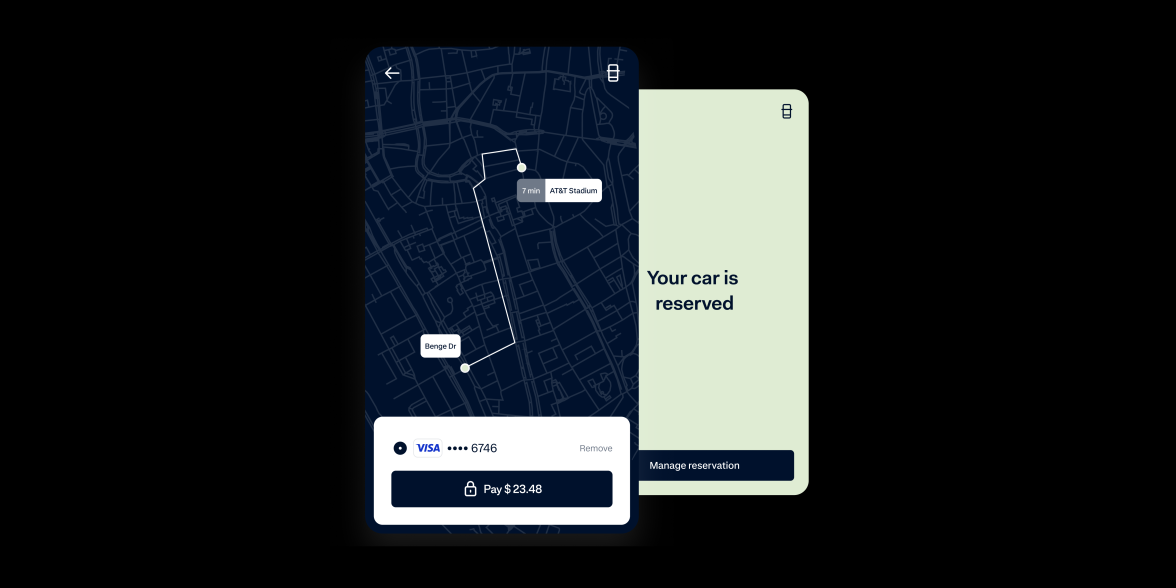
Winning the last-minute booking race
During a tournament, the booking window can collapse from weeks to minutes. A surprise result can send thousands of fans to their phones at once to secure a seat on the next train, flight, or rideshare. In these "scramble" moments, the merchant who wins the transaction is the one who offers the least resistance.
Treating payments as part of the logistics stack is essential. Dynamic Currency Conversion (DCC) helps fans understand costs instantly, avoiding exchange-rate calculations in the back of a cab. Automatic recognition of preferred methods, whether CUP, JCB, or a digital wallet, reduces drop-off by removing the need to retype card details under time pressure.
This is the first tournament of its kind where agentic commerce will play a major role. According to IDC, by 2026 AI agents will act as “digital watchdogs,” handling the logistical heavy lifting for fans in real-time. Instead of a fan manually refreshing a travel site, an agent can be tasked to monitor a match score and instantly book the best flight the moment a team advances.
Beyond just flights, these agents can also act as trip architects, instantly stitching together local dining, transport, and entertainment that fits a fan’s specific profile and location. For travel and mobility businesses, this means “discoverability” is evolving.

What travel and mobility operators must get right
Build matchday flexibility into booking systems. Support easy changes, cancellations, and multi-city itineraries as fans shift plans.
Support truly global payment methods. Accept regional schemes, cards, wallets, and local debit options side-by-side.
Optimize authorizations for cross-border journeys. Use tools like premium-card routing and tokenization that improve approval rates on international, high-value bookings.
Provide instant price certainty with DCC. Remove the friction of real-time exchange rate calculations so fans can book with confidence during high-pressure travel moments.
Entertainment and experiences

High-intent soccer fans don’t take days off
Aside from the main tournament itself, host cities are building full fan ecosystems around the matches. Mexico City, for example, will turn the Zócalo into one of the world’s largest FIFA Fan Festivals, with giant screens, concerts, sports activities, and cultural exhibitions, while additional fan zones across its 16 boroughs are designed to keep visitors in the city’s museums, food markets, and nightlife between games. Between matches, fans will look for ways to extend the experience through food, culture, and shared activities, and these visitors are outspending locals even in some everyday categories such as casual dining.
According to Expedia Group, the majority of sports travelers (62%) now opt for “marathon stays” of between 2 and 6 days, with nearly one in five staying for a week or longer. These visitors consistently outspend locals.
Our data from summer 2025 across the US found that tourists spend roughly $10 more per meal than locals (this was even more in California at $20) and around $5 more in fast-food outlets. Chinese and Hong Kong visitors sit at the top of this “downtime economy,” with average spends above $40 per person, compared with local averages closer to $29–$30.
Because many of these purchases are spontaneous and mobile-first, the payment often becomes the most decisive step in the journey. Whether a fan is booking a same-day museum slot or a last-minute post-match celebration, they expect a few taps and instant confirmation. Providers that minimize friction for these same-day, high-intent transactions are best positioned to capture incremental revenue on rest days.
Make payments a part of the experience
To capture high-intent demand, operators must shift from simple processing to a high-speed, globally reliable strategy. By implementing unified payments, entertainment providers can connect mobile discovery with in-person attendance on a single platform.
This cross-channel visibility is vital for managing tournament volatility, as it allows systems to spot repeat guests and stop high-value declines during sudden peak windows. A unified approach also lets entertainment and experience businesses tailor interactions to real-time nationality mixes, ensuring local e-wallets and home-currency pricing are always available to reduce purchase hesitation.
Vancouver's Fan Festival at Hastings Park (PNE grounds)—with capacity to host 25,000 fans will feature not just game broadcasts but also live concerts and immersive fan experiences. It can expect to draw crowds from the likes of Australia, Qatar, New Zealand, and Egypt alongside locals in the tournament's early stages.
Kansas City's Fan Fest at the National WWI Museum also boasts 25,000 fan capacity and features stages, video boards, skills challenges, and watch parties while the city hosts those from Austria, Algeria, Ecuador, Curaçao, Tunisia, the Netherlands, and Argentina—Messi enthusiasts will no doubt abound.
What entertainment and experience operators must get right
Offer fast, mobile-first checkout. Many purchases happen same-day, often on mobile devices.
Accept global payment methods. Support international cards, wallets, and preferred regional options.
Optimize authorization rates. Last-minute purchases leave little room for payment retries.
Prepare for group and bundled purchases. Families and fan groups often buy together.
Scale effortlessly during peak windows. Be ready for sharp demand spikes around match days and rest days alike.
Hospitality

Revenue is won in the knockout stages
When the world’s biggest sporting event comes to town, hotels become the heart of the host city’s ecosystem. Demand spikes, stays lengthen, and international guests dominate bookings across host cities.
Early signals from US host cities already point to record pressure on inventory. In markets around MetLife Stadium in New Jersey, hotel booking volumes for the week of the 2026 final are up more than 100% year over year, with average daily rates more than 70% higher than the same period a year earlier. For the US opening match in Los Angeles, nearby destinations are seeing booking volumes up over 80%, with double‑digit rate growth as hotels lock in early demand.
Our data from our 2024 Summer Games in Paris proves this spending power is real. Chinese shoppers spent nine times the industry average per transaction in luxury retail. This reveals a critical operational need for the upcoming tournament. These same guests expect their hotel to reliably authorize luxury-tier stays and incidental holds that frequently range between $1,000 and $5,000 without the friction of international fraud flags.
This impact will be felt on a grand scale. Deloitte expects the tournament to be a massive revenue driver for Mexico’s hospitality sector, predicting a surge in hotel spending and employment that will spill over into neighboring states, creating a nationwide economic win.
To capture this opportunity, hoteliers should look beyond occupancy and toward total wallet share. Tournament-driven travel can be fluid, with guests changing cities or extending stays as teams progress. Properties that handle these changes smoothly can protect revenue and guest satisfaction, while fragmented systems risk friction exactly when their most valuable guests are most active.
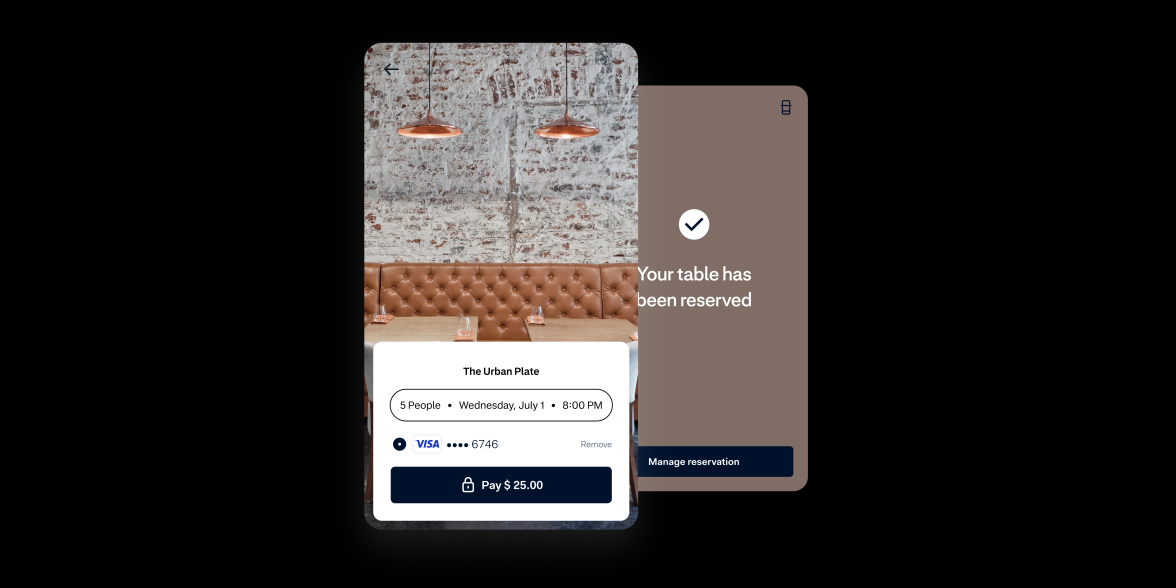
Connect every guest touchpoint
The ‘luxury multiplier’ isn’t captured at the front desk alone. It's built through each spontaneous decision a guest makes from a late-night bar tab, a last-minute spa booking, or a premium viewing experience.
By unifying payments across the property, hotels remove the small barriers that discourage these decisions. When a guest can seamlessly charge to their room or pay via a preferred digital wallet without re-authentication, incidental spend becomes a core revenue stream rather than an afterthought. The aim is a consistent loop where high intent is matched with instant ability to pay, at every touchpoint.
What hotels must get right
Prepare for international demand. Ensure acceptance of global cards, e-wallets, and currencies.
Support flexible bookings and changes. Allow smooth modifications without payment friction.
Optimize authorizations and deposits. Limit declines on high-value stays and incidental holds.
Unify payments across the guest journey. Connect online bookings, front desk, and on-property spend.
Plan for peak intensity. Stress-test systems for high-volume arrivals and departures.
The final whistle

Turn a global moment into lasting growth
The world’s biggest soccer event is a high-impact window where domestic volumes meet international spend premium. With Americans and Mexicans leading ticket sales, the pressure is on. Your business must handle the sheer scale of the home-turf crowd while seamlessly capturing high-value global demand.
Businesses that prepare for these moments by building flexible operations and easy global payments are better positioned to turn a moment into momentum. The capabilities that power success during the tournament don’t disappear when it ends. They become the foundation for what comes next.