Article
Payment processing: What it is and how to evaluate a payment processor
Payment processing is the global financial infrastructure that keeps commerce moving. Learn more about how it works, the ways it affects your business’ profitability, and how to evaluate a payment processing service.

Behind every successful "transaction approved" message lies a sophisticated global network of communications, verifications, and integrations. This is the world of payment processing: the infrastructure that supports the effortless movement of money between consumers and businesses worldwide.
While it’s an integral part of our daily lives, the underlying technology is complex. In this guide, we break down exactly how these payment processing systems function, how they impact your bottom line, and how to choose a partner that turns payments into a competitive advantage.
You’ll learn:
What is payment processing
How payment processing works
AI in payment processing
How payment processing stays secure
How payment processing affects your business profitability
How to evaluate a payment processing service
What is payment processing?
Payment processing is the automated, secure sequence of actions that helps merchants accept electronic payments such as cards and e-wallets by transferring funds from a shopper to a merchant account. Payment processing systems support financial transactions between customers and merchants. They cover the entire journey of handling and moving funds from a customer's account to a business's account after a cashless transaction is initiated online, in-person, or in an app.
Payment processing has evolved over decades. Today, it’s a modern digital ecosystem that keeps business moving. Its core goal is simple: transfer funds securely and efficiently at scale.
What is online payment processing?
Online payment processing is the digital workflow that authorises and settles electronic transactions. It allows merchants to accept payments securely across various devices and platforms.
Payment processing technologies
Part of what makes payment processing so impressive is its speed. That’s only possible because of a sophisticated tech stack that balances two competing priorities: frictionless speed for the customer and strong security for the business.
As consumers, we’re all familiar with the critical touchpoints where data is captured, protected, and moved:
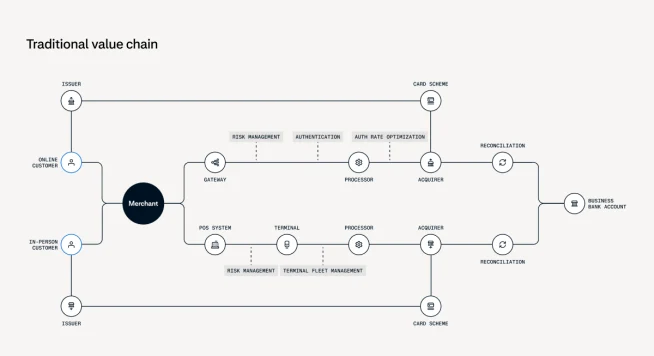
Payment gateway: A service portal that securely captures, encrypts, processes, and transmits payment data between point of sale systems and banks
Point of Sale (POS) device: Physical devices or digital platforms where a customer initiates the payment
Credit cards and debit cards: Physical or digital financial instruments used by customers to initiate payments
Digital wallets: A common electronic payment method that lets customers store their payment information on a phone or smart device for payments without presenting a physical card
There is also an invisible infrastructure that ties all of these touch points together. A few of these core technologies include:
Payment networks (card schemes): These are the global "highways" like Visa, Mastercard, and American Express. They provide the central infrastructure that sets the rules and communicates between the merchant's acquirer and the customer's bank.
Acquiring host (processor): Processors connect the merchant to the payment networks. They’re responsible for the technical heavy lifting: routing the transaction to the right network and ensuring the data follows the correct protocols.
3D Secure (3DS): A security protocol that adds an authentication step to verify the cardholder's identity for online payments. It often runs in the background, though some transactions ask the shopper to complete an extra step.
How payment processing works
Payment processing is a sophisticated, fast, and secure workflow. Authorization usually takes seconds, while the time until funds reach a merchant’s bank account depends on the payment method, capture timing, payout schedule and bank processing. For a typical card payment, it’s broken into two phases: the transaction and the settlement. Other payment methods can follow different processes.
Phase 1: The transaction
The first part of the payment processing workflow is the payment approval process. As soon as a customer initiates a transaction, several events occur in rapid succession:
The gateway captures critical data: The payment gateway will capture critical customer information like their name, payment credentials, and other identifying details. Then, it encrypts that data so it stays safe.
The gateway forwards that information: Once encrypted, the data gets sent to a merchant service provider. The merchant service will then validate the information and forward it to the card processing network associated with the card.
The processing network communicates with the issuing bank: In seconds, the processing network communicates with the issuing bank and provides the transaction details. The issuing bank will then complete extra verification checks and confirm whether there are enough funds or available credit to cover the transaction.
The issuer’s decision comes back: The issuing bank approves or declines the transaction, and the processing network relays that decision back to the merchant terminal or gateway so the customer can finish the transaction.
The customer receives the result: The approval process usually takes seconds. If approved, the customer receives confirmation at the terminal or checkout.
Authorization approves the payment but does not itself pay the merchant. Capture, settlement and payout follow.
This diagram illustrates all payment processing steps from payment initiation to settlement:
Read next: How to choose the right merchant services provider
AI in payment processing
Artificial intelligence is changing how financial transactions are processed, approved, and protected. By analyzing large volumes of transaction data in real time, AI can help optimize payment flows, improve authorization performance, and detect fraud more effectively.
The main ways platforms use AI in payment processing include:
Intelligent payment routing: AI can analyze transaction signals to determine the most effective routing path, helping businesses balance payment costs and authorization performance.
Real-time fraud detection: Machine learning models can analyze signals such as device data, transaction behavior, and payment history to identify potentially fraudulent activity while reducing false declines. More than 80% of organizations in APAC have implemented AI-driven fraud detection solutions to protect transactions in real time.
Smart retries: AI can help determine when and how to retry certain failed payments, helping businesses recover legitimate transactions without unnecessary friction for shoppers.
For example, Adyen Uplift uses machine learning and Adyen’s global payments data to help businesses optimize conversion, manage fraud risk, and reduce payment costs.
How does payment processing stay secure?
Payment processing systems stay secure through a combination of data protection technologies, advanced fraud detection mechanisms, and strict regulatory compliance.
The primary methods used to maintain security include:
Tokenization
Tokenization involves substituting sensitive payment card information with a unique placeholder, known as a "token". By using a token, merchants can process charges, perform refunds, or void transactions without ever storing the actual card data on their systems, significantly reducing the risk of exposure.
Encryption
Technologies like Point-to-Point Encryption secure cardholder data during transmission. This ensures that clear-text payment information is never accessible within the merchant's network.
Address Verification Service (AVS)
AVS acts as a fraud-prevention tool, particularly for online (card-not-present) transactions. It verifies the cardholder's submitted billing address against the address on file with the card issuer.
Artificial intelligence and advanced anti-fraud measures
Payment processors conduct real-time checks using parameters like the card's country of issue and previous payment history to gauge the legitimacy of a transaction. Modern platforms also deploy AI and machine learning to detect fraud in real-time, reducing false declines while optimizing the overall conversion rate.
Security standards and compliance
Robust payment solutions must adhere to strict regulatory standards, most notably PCI DSS (Payment Card Industry Data Security Standard) compliance. Processors also operate in the background to ensure that all transactions strictly comply with the specific regional rules and standards of the country where the business operates.
How does payment processing affect profitability?
The right payments setup improves your bottom line and sets your business up for growth. Optimizing your payment processing reduces costs, increases conversion, and even opens up entirely new ways to make money.
Reduced transactional and operational costs
Every transaction has a price tag, but smart processing keeps those costs down:
Intelligent routing: Where available, some processors use AI to route payments across eligible networks to help manage costs and authorization performance.
Local acquiring: Processing payments locally instead of can help reduce international fees for eligible transactions and keep conversion rates high.
Cheaper payment methods: Local payment methods like PayNow and Grabpay can save businesses on average per transaction, compared to credit and debit cards.
Operational ease: A single, unified platform automates manual tasks like reconciliation. This frees up your team for higher-value work.
Increased conversions and revenue
A smooth payment flow helps you avoid losing customers at the finish line:
Higher conversion rates: Advanced fraud detection can help distinguish potentially fraudulent transactions from legitimate ones and reduce false declines.
Reduced cart abandonment: By offering a customer’s preferred local payment method and automatically keeping card details updated where supported, you can help stop sales from falling through.
Unlocking new revenue streams
For SaaS companies and platforms, payments can transition from an expense to a profit center.
White labeled service: By , platforms can offer payments to their users under their own brand, while the underlying payment services are provided by the payment provider.
New revenue through fees: Platforms may earn revenue from fees charged for integrated payment services, subject to their commercial arrangements. Payment processing and other provider fees still apply.
How to evaluate a payment processing service
The payment processing platform you use needs to match your business needs. When evaluating, consider a platform’s security features, its global footprint, currency options, and integrations.
Other critical factors to consider include:
The quality of the customer checkout experience
A unified reliable architecture with minimal points of failure and consistent uptime
The availability of real-time analytics and reporting
Dependable 24/7 customer support
The overall total cost of ownership, which includes transaction and setup fees
You should also look at the architecture of the platform. At Adyen, payment processing is part of our solution, which lets you connect payments data across your channels. That way you can deliver consistent, smooth payment experiences across supported channels and markets through one platform.
Payment processing is the foundation of modern business
In a world where customer expectations and security threats are constantly evolving, your payment processing strategy cannot afford to be static. By understanding the journey of a transaction, you can optimize your operations, reduce unnecessary costs, and provide a frictionless experience for your customers.
Curious how to reduce the overall costs of payments? to learn how things like intelligent routing and local payment methods can help you reduce costs.
Key summary
What is payment processing?: Payment processing is the underlying infrastructure that securely handles and moves funds between a customer's account and a merchant's account.
Speed relies on a complex tech stack: A sophisticated ecosystem of payment gateways, processing networks, acquiring hosts, and 3D Secure balances fast, frictionless checkouts with strong security.
The process happens in two phases: For a typical card payment, authorization usually takes seconds, while settlement and payout happen afterwards, on a timeline that depends on the payment method and payout schedule.
Multiple layers help protect payments: Sensitive payment data is protected through a combination of tokenization, encryption, AI-based fraud detection, and PCI DSS compliance.
Optimized processing boosts profitability: Smart payment strategies reduce operational costs via intelligent routing, improve conversion rates with local payment methods, and can even unlock new revenue streams like white-labeled payments.
Frequently asked questions
Credit card processing functions much like general payment processing, specifically handling transactions when a customer swipes, inserts, taps, or enters their credit card details online. The card processor acts as a communicator between the payment gateway, the specific card scheme or brand (like Visa or Mastercard), the customer's issuing bank, and the merchant's acquiring bank.