Article
Why investment brokers need to rethink their infrastructure for payments
Modern investment funding is exposing liquidity and compliance challenges that traditional payment infrastructure wasn't designed to solve.


Mobile-first platforms, lower barriers to entry, and fractional shares have made investing accessible to more people than ever before.
As a result, investors are funding their accounts more frequently with smaller amounts and expect the experience to work like every other app on their phone: tap to pay, instant confirmation, and immediate access to invest.
The problem is that the infrastructure powering many investment platforms wasn't built for these expectations.
In this article, I’ll explain why this creates liquidity challenges that most traditional payment providers weren’t designed to solve and what changes when payments, customer segregation, and settlement run through a single platform.
If you're exploring how to introduce or scale card payments without those trade-offs, we'd be glad to walk you through how Adyen approaches this in practice. Get in touch to learn more.
The challenge of balancing client satisfaction with liquidity and compliance
Investors expect their experience with a trading platform to match every other app on their phone. But the way most platforms handle funding, settlement, and compliance hasn't caught up yet.
Here’s a breakdown of the challenges investment brokers face when trying to keep this new wave of investors happy:
Investors want to fund their accounts quickly with cards or wallets
Investors are used to paying with a single tap via cards or digital wallets like Apple Pay. Many are thinking in terms of a subscription, funding their account with a set amount each month straight after payday. They also expect their payment to go through quickly with easy user experiences.
Funding has become part of the product experience. Any friction at this stage shapes how investors perceive your platform before they’ve even made their first investment.
Investors expect to be able to invest as soon as they’ve funded their account
When an investor funds their account, they want to be free to invest as soon as the payment is captured. But from the broker's side, since payments often do not settle immediately, this means funding the investment before the client's payment has settled into their account.
SEC Customer Protection Rule (15c3-3) requires brokers to keep customer funds in a dedicated reserve account, separating them from the firm's own business capital. Since most payments take two or more days to settle, to enable immediate investment brokers end up fronting both the investment and the client money segregation requirement from their own capital. Earlier access to customer funds reduces the amount of capital brokers need to front, lowering credit risk and enabling them to extend instant investing to more customers.
These requirements increase further over weekends when clearing networks pause and the settlement window extends.
It also creates an ongoing compliance burden. Firms must be able to demonstrate at any time that the amount of client money they hold matches the amount they owe customers. When funds move between payment providers and banking partners, reconciling operational funds with segregated client money becomes more complex, increasing both compliance effort and operational risk.
Why a fragmented infrastructure is holding brokers back
Liquidity strain, compliance burden, and operational drag look like separate problems because they're owned by different teams. But they all trace back to the same root cause: disconnected infrastructure.
For example, a typical setup might look something like this:
Payments are acquired by your PSP
The money is transferred to your banking partner
Your client money account sits with a different provider
Due to multiple bank accounts for client and operational money, each money movement means additional reconciliation efforts
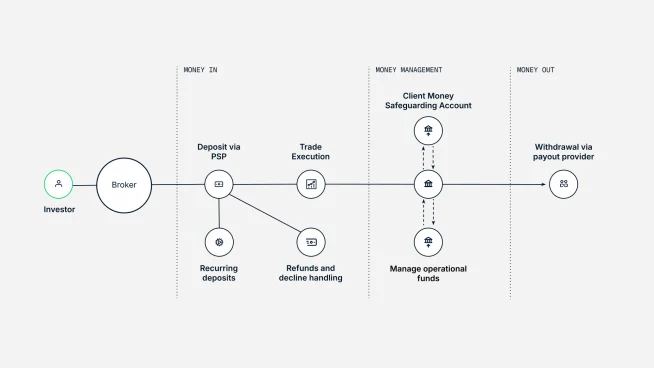
Money has to move between all four before a transaction is complete, and each leg of that journey runs on its own settlement timeline.
When an investor wants to withdraw funds, the payout has to travel back through multiple providers, often via a different provider than the one that processed the original deposit. Each handoff adds time, and the investor is left waiting.
Reconciling all of this is equally complex. There's no single record showing acquired funds, client money balances, and pre-financed positions. Instead, your team must manually match figures across systems, every single day, with the risk of error rising in line with your transaction volume.
None of this is any one provider's fault. It's the natural outcome of stitching together acquiring, banking, and treasury functions from separate vendors, each optimized for their own role rather than the full flow of money through an investment platform.
What changes when payments, segregated accounts, and settlement run on one platform
If you’re processing payments and managing capital through separate providers, the solution isn’t a bigger capital buffer or more sophisticated spreadsheet. It's removing the gaps between providers in the first place.
Unlike many payment providers, Adyen holds a banking license in the US, EU, and UK. We can offer investment brokers something a lot of PSPs can’t: a single platform to accept payments, hold client funds, and manage money flows.
Here’s what you can expect if you partner with us:
Unlock working capital
If your PSP takes two or more days to settle, you’ll end up funding trades and client money segregation from your own operational capital. Adyen can settle amounts investors fund into your account on the same day, reducing the strain on liquidity required and freeing up working capital that would otherwise remain tied up.
Protect client money from the moment a payment is captured
Traditional payment setups split acquiring and banking, leaving customer funds in transit across separate entities for days. This creates operational friction under SEC Rule 15c3-3, which mandates strict possession, control, and segregation of customer cash.
With Adyen’s unified platform, acquiring and client balance accounts live under one roof. Account funding is recognized and directly routed into a compliant customer reserve account upon settlement — closing the transit gap and keeping your brokerage compliant.
Simplify reconciliation with a single source of truth
When acquiring, client money, and settlement sit with separate providers, someone has to manually match acquired funds, client money balances, and pre-financed positions across systems. Each provider maintains its own records, creating delays, discrepancies, and additional compliance work.
When these functions run on a single platform, every transaction is recorded against the same source of truth. Payments, client fund balances, and settlements are automatically linked, making it much easier to reconcile funds, prove compliance, and identify exceptions without stitching together data from multiple providers.
Put idle capital to work
With the right infrastructure, you ensure there is no unnecessary money in-transit, which creates an optimized time to yield interest returns on client balances. In some cases, this can result in a partial offset of the cost of processing card payments, turning what was previously a pure compliance cost into a revenue stream.
Payments are not the challenge, the supporting infrastructure is
The pressure to offer seamless payment experiences will only grow as new investors enter the market.
The question is whether the partners you choose to work with can keep pace, without eating into your liquidity, stretching your compliance team, or adding operational risk.
Most standard PSPs weren’t built to answer that. They can take a payment, but they can't hold your client's money, settle on your timeline, or give you a single view of where your funds are at any point. That's a structural limitation, which is why bolting on more reconciliation processes or a bigger capital buffer only goes so far.
As funding becomes a bigger part of the investment experience, infrastructure matters just as much as payment acceptance. Bringing acquiring, banking, safeguarding, and settlement together can reduce operational complexity while giving firms more flexibility to grow.
If you're exploring how to introduce or scale card payments without those trade-offs, we'd be glad to walk you through how Adyen approaches this in practice. Get in touch to learn more.