2026 SMB PAYMENTS REPORT
The state of SMB payments in the US

What's in this report
Embedded payments represent a significant opportunity for SaaS platforms serving SMBs in the US.
By embedding payments directly within the software SMB customers already use, platforms can play a more central role in how these businesses operate: simplifying operations, reducing reliance on separate providers, and laying the groundwork for broader financial services.
Adoption is already gaining momentum. 65% of US SMBs use their platform’s embedded payments solution, and one in three non-users are “considering adoption” within the next 12 months.
That said, adoption isn’t automatic. SMBs still weigh the benefits of switching against existing payment processes, perceived complexity, and the need for flexibility.
For platforms looking to grow their embedded payments offering, understanding what drives adoption, what creates hesitation, and what encourages deeper usage is key.
To understand the current landscape, Adyen partnered with Visa to survey 1,506 SMBs globally, including 500 in the US, between January and March 2026. This benchmark examines five areas shaping SMB adoption of embedded payments in the US:
Adoption drivers
Adoption barriers
Perceived value
Industry patterns
Opportunities beyond payments
Methodology: Based on an Adyen and Visa survey of 500 US SMBs, conducted January to March 2026. Respondents were decision-makers for payment systems at businesses with up to 250 employees, all using software platforms. Global comparisons draw from the full dataset of 1,506 SMBs across the UK, US, and Germany.
How the US compares to other markets
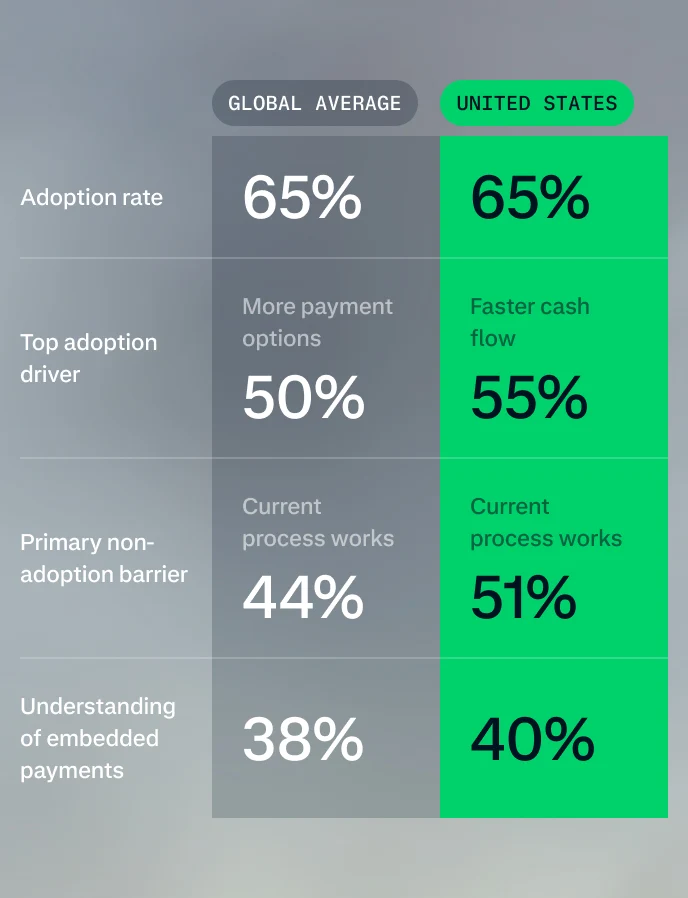
US adoption is in line with the global average at 65%. What differs is why SMBs are adopting. Globally, “more payment options” tops the list of adoption drivers, with “faster cash flow” close behind. In the US, those priorities are reversed, with faster access to funds coming out on top.
Among US SMBs not considering adoption, 51% say their “current process works”, higher than the global average. This suggests they’re more comfortable with the status quo, so the case for switching needs to be especially clear: what’s better, and why is it worth changing?
Faster access to funds is the leading adoption driver
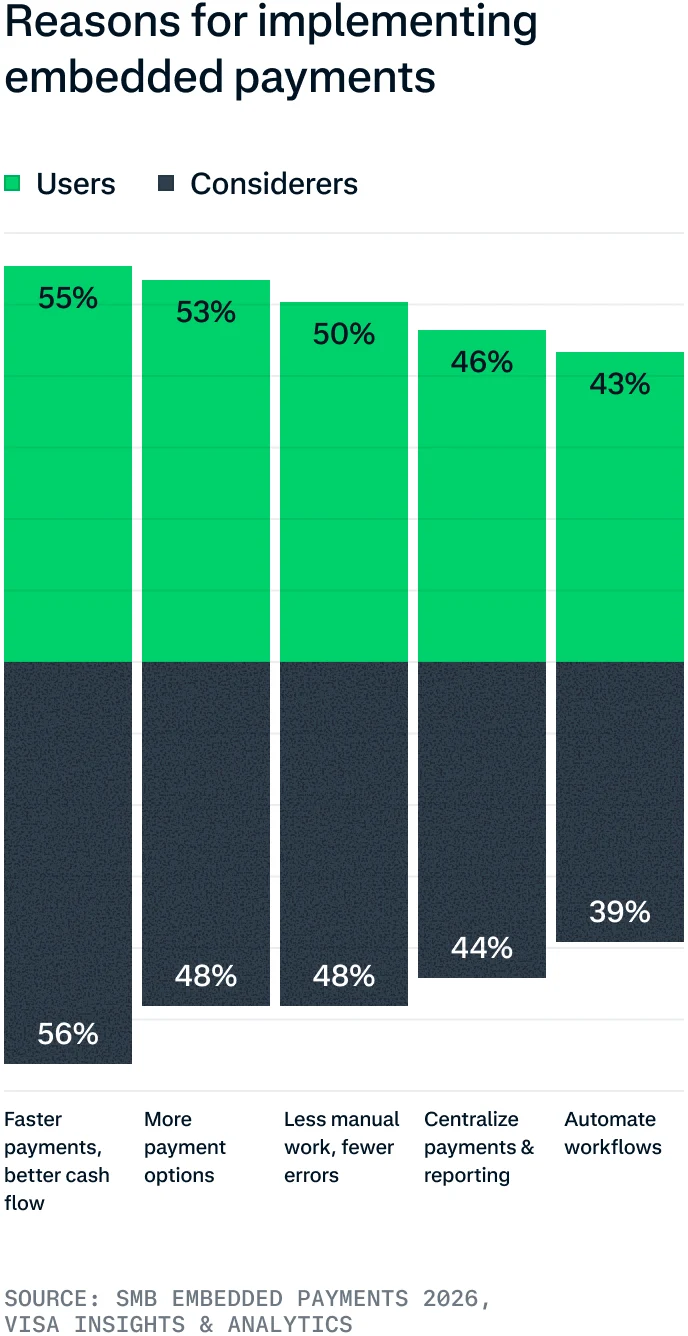
55% of US SMBs cite faster access to funds as a key reason for adopting embedded payments, making it the strongest driver in the market.
This reflects the operating environment facing many SMBs today. Rising costs, tighter margins, and financial uncertainty mean faster payouts can have a direct impact on business performance.
However, liquidity is only part of the story. Other leading adoption drivers include:
More payment methods accepted (53%)
Reduced manual work (50%)
Together, these findings point to a broader demand for payment solutions that remove operational friction as much as they process transactions.
For SaaS platforms, this reinforces an important point: embedded payments should be positioned around business outcomes. Faster cash flow, simpler operations, and greater efficiency resonate more strongly than technical payment features alone.
Existing payment habits remain the biggest adoption hurdle
For US SMBs that have not yet adopted their platform’s embedded payments solution, the biggest challenge is confidence that changing their current process will create enough value.
Many SMBs already have established payment relationships and workflows, with PayPal (56%) and Square (42%) among the most widely used providers. As a result, the most common reason non-users give for not switching is that their current payment process “works well” (51%).
Among US SMBs considering adoption, the leading barriers include:
Preference to keep payments separate for control or simplicity (30%)
Perceived cost (26%)
Payment method coverage concerns (25%)
These objections are not limitations of embedded payments, but areas where platforms can better demonstrate value.
Simplicity concerns can be addressed by showing how an integrated solution reduces operational complexity, while flexible or standalone options can support different adoption needs.
Cost concerns can be reframed around total value, including time saved on reconciliation, reduced manual effort, and improved visibility.
Payment method concerns can be addressed by demonstrating the breadth of payment options available through embedded solutions.
For SaaS platforms, the opportunity is to move the conversation beyond payment processing and show how embedded payments improve the wider business workflow.
US SMBs recognize value beyond payment acceptance
SMBs already using their platform’s embedded payments solution report benefits that extend beyond processing transactions:
Improved payouts (88%)
Better customer experience (88%)
Reduced administrative effort (86%)
This reflects how deeply payments influence the day-to-day reality of running a business. They touch wider operational processes like invoicing, reconciliation, reporting, and customer interactions. When these workflows connect, SMBs spend less time on manual work and have better visibility of their finances.
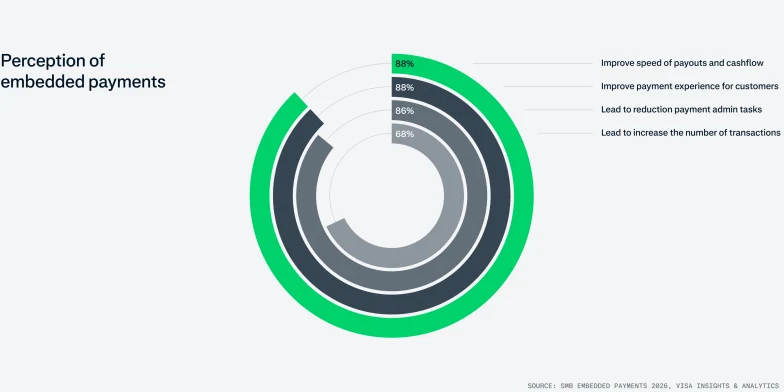
However, the value of embedded payments is not yet fully realized. While SMBs recognize improvements in efficiency and experience, they’re less likely to understand commercial impact, like transaction growth or revenue generation. Without that baseline, payments can be seen as a cost to manage instead of a strategic advantage.
For SaaS platforms, the opportunity is to make that commercial value more tangible, and help SMBs quantify the impact of embedded payments on their business.
Industry context shapes how platforms unlock embedded payments value
Healthcare: Solving operational complexity
Of the SMBs surveyed in the healthcare industry, 72% report adopting their platform's embedded payments solution. While it represents a high adoption rate, only 29% say they fully understand embedded payments as a concept.
This suggests that adoption is often driven by solving an immediate operational challenge — billing, reconciliation, and reporting — rather than a clear awareness of embedded payments as a category. It does point, however, to a growing shift away from legacy payment setups and towards software providers that fit naturally into their workflows.
Healthcare platforms can deepen awareness by helping SMBs see value beyond operational fixes, like faster payouts and payment method flexibility.
Retail: Unifying fragmented channels
Retail SMBs show strong adoption (69%), supported by demand for more connected payment experiences. 91% view embedded payments positively, citing faster payouts, improved checkouts, and reduced administration among the top benefits.
However, managing payments across in-store, online, and mobile channels remains fragmented for many retail SMBs. Over half (56%) want an integrated POS system, pointing to a clear appetite for true unified commerce.
For retail platforms, the opportunity is to connect payments to the broader commerce workflow: unified reporting, local payment method coverage, and data that helps SMBs understand how and where customers are paying.
Professional services: Modernizing complex billing
Professional service SMBs show lower adoption (59%), reflecting an industry where manual invoicing, custom payment terms, and complex billing structures remain the norm.
That said, perception of embedded payments is positive. An equal number (87%) of respondents cite faster payouts and reduced administrative burden as top advantages.
For software platforms serving professional services, the opportunity lies in simplifying these intricate billing lifecycles — automating collections, streamlining reconciliation, and giving SMBs real-time visibility into their financial health.
Across industries, the themes are consistent.
Platforms that help SMBs unlock greater value from their payment setup become further embedded in how those businesses run. The focus shifts from increasing adoption to connecting transactions with the workflows, insights, and experiences SMBs need to be successful.
Embedded payments create the foundation for broader financial relationships
Embedded payments can become the starting point for deeper financial relationships between SaaS platforms and their SMB customers.
Today, traditional providers remain the primary source of SMB financing, with 42% of US SMBs borrowing from banks compared to 16% borrowing through their software platform. However, SMBs increasingly value financial products that are simpler, faster, and more connected to how they actually operate.
Platforms with an established payments relationship can help create a more seamless experience by connecting SMBs with relevant financial products, including those offered by financial institution partners.
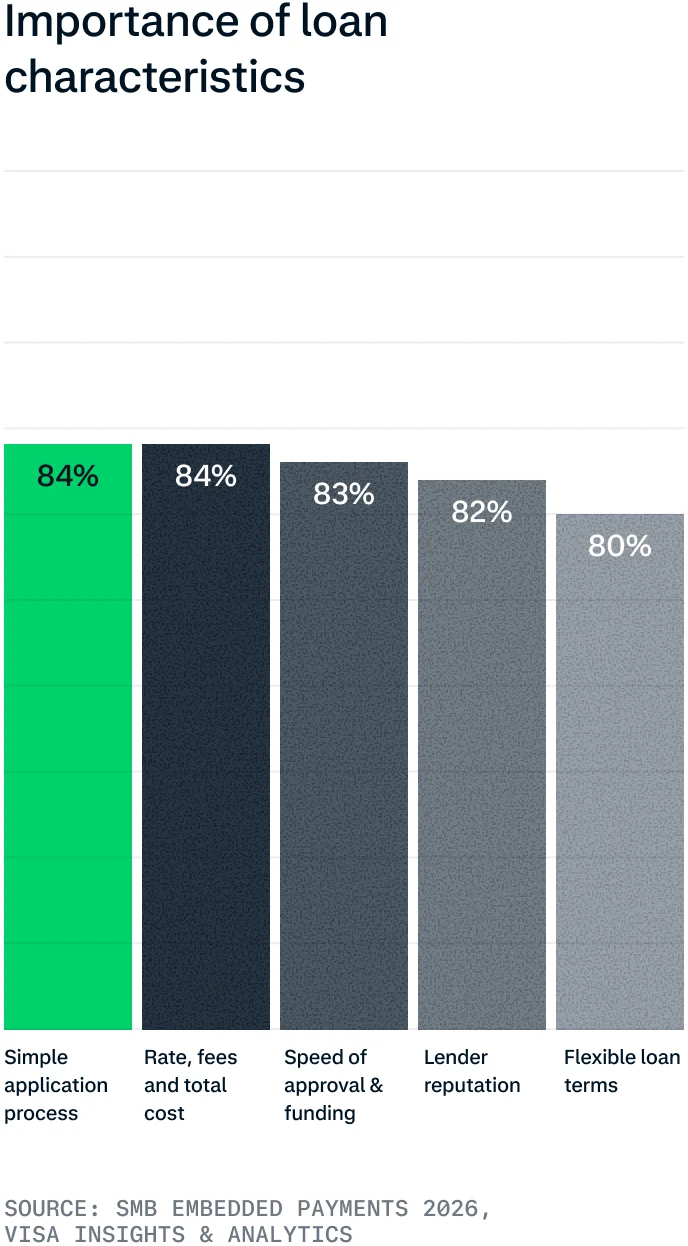
Embedded payments give platforms valuable transaction history, customer relationships, and operational context that can help make these financial experiences more relevant over time. For example, payment data can provide insight into an SMB’s revenue patterns and business activity, helping platforms and their financial partners deliver products that better reflect the needs of the business.
But trust remains critical. Financial products require a deeper relationship than payments alone, meaning platforms need to establish value through the everyday experiences SMBs rely on before extending into broader financial services.
The takeaway:
Payments come first. They can create the foundation for broader financial relationships over time.
Embedded payments adoption is growing, but platforms must earn deeper trust
The US embedded payments market is maturing. Adoption is growing, market understanding sits above the global average, and the opportunity to expand beyond payment processing is clear.
US SMBs aren’t waiting to be convinced that embedded payments work, they’re deciding which platform is worth trusting with more of their business.
For SaaS platforms, that trust is built by delivering clear, consistent, and specific value every day.
Five principles for building in this market
Lead with the problems SMBs need to solve
Faster cash flow, reduced friction, and operational efficiency are the strongest adoption drivers. Start the conversation there.
Turn existing processes into opportunities
Many SMBs are comfortable with current payment setups. Platforms should show where (and how) embedded payments remove inefficiencies.
Expand beyond payment acceptance
The strongest opportunities come from connecting payments to workflows, customer experiences, and business insights.
Tailor the value proposition by industry
As seen in healthcare, retail, and professional services, adoption varies by industry. Platforms should align their pitch to sector-specific needs.
Payments are the foundation
Embedded payments create the trust and data needed to expand into broader financial services over time.
About
Methodology
Based on an Adyen and Visa survey of 500 US SMBs, conducted January to March 2026. Respondents were decision-makers for payment systems at businesses with up to 250 employees, all using software platforms. Global comparisons draw from the full dataset of 1,506 SMBs across the UK, US, and Germany.
About Adyen
Adyen (AMS: ADYEN) is the financial technology platform of choice for leading companies. By providing end-to-end payments capabilities, data-driven insights, and financial products in a single global solution, Adyen helps businesses achieve their ambitions faster.
About Visa
Visa (NYSE: V) is a world leader in digital payments, facilitating transactions between consumers, merchants, financial institutions and government entities across more than 200 countries and territories. Learn more at Visa.com
Disclaimers:
Comparisons, statistics, research and recommendations are provided “AS IS” and intended for informational purposes only and should not be relied upon for operational, marketing, legal, technical, tax, financial or other advice. Visa neither makes any warranty or representation as to the completeness or accuracy of the information within this document, nor assumes any liability or responsibility that may result from reliance on such information. The Information contained herein is not intended as investment or legal advice, and readers are encouraged to seek the advice of a competent professional where such advice is required.
All brand names and logos are the property of their respective owners, are used for identification purposes only, and DO NOT imply product endorsement or affiliation with Visa or Adyen.
Get the report's key insights
A summarized PDF to read, share, or revisit later.