Article
Perpetual licenses: What they are and how they compare with subscriptions
Software billing can take several forms. While perpetual licenses have largely been phased out, they still make sense in some cases.

Today, it’s hard to imagine a time when software was sold for a one-time fee. But not too long ago, perpetual licenses were the standard.
A perpetual license gives a customer the right to use a specific version of software indefinitely in exchange for a single upfront payment.
Before cloud delivery, software was sold through perpetual licensing agreements. Once vendors could host software and update it continuously, however, a one-time fee no longer matched how products were built or supported. Subscriptions became the default, and perpetual licenses became the exception.
Though perpetual licenses have largely been phased out, they still make sense in some cases. Keep reading to learn about:
What a perpetual license is
How perpetual licenses compare with SaaS subscriptions and term licenses
The advantages and disadvantages of perpetual licensing
How to recognize revenue with perpetual licenses
What is a perpetual license?
A perpetual license is an agreement that gives a customer the right to use a specific version of a piece of software with no expiration date. The customer pays once and does not need to renew to keep using the software.
Support is usually sold separately. Updates, security patches, technical support, and major upgrades typically come through an annual maintenance agreement. Customers who let maintenance lapse can keep using the version they bought, but that version will no longer receive updates or security fixes.
With a perpetual license, the customer receives usage rights, not ownership. Vendors retain the code and the intellectual property, and the license agreement defines who can use the software, where it can be deployed, and whether the license can be transferred.
Examples of perpetual licenses
A few examples of perpetual licenses include:
A one-time purchase of Microsoft Office Home 2024 unlocks the 2024 version of Word, Excel, PowerPoint, and OneNote.
The 3D CAD software SOLIDWORKS says perpetual licenses are the most popular option among their customers.
Remain Software offers both perpetual licenses and software subscriptions.
Perpetual licenses vs. SaaS subscriptions
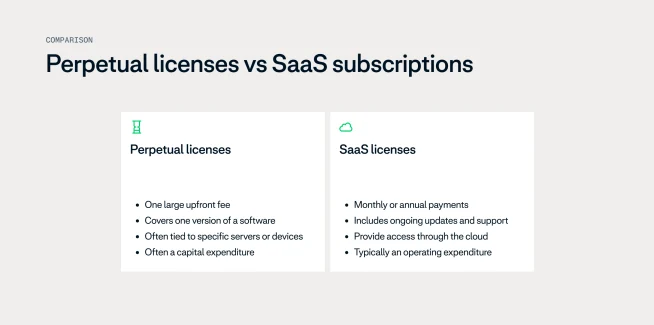
The shift away from perpetual licenses towards subscriptions began when software became a cloud-based service. Instead of shipping a version for customers to install, vendors can now host the product, update it continuously, and charge a recurring fee for access.
When comparing term vs. perpetual software licenses, the main difference is duration. A term license expires, while a perpetual license does not. But there are also a few other key differences:
Advantages and disadvantages of perpetual licensing
Perpetual licenses offer certainty for the buyer, but they have become less common for a good reason. The trade-offs look different depending on which side of the contract you’re on.
For customers
Perpetual licenses are no longer the default, but they haven't disappeared. They still suit customers who need version control, on-premise deployment, or a fixed upfront cost.
Advantages
Budget certainty: One upfront investment instead of ongoing fees.
Version stability: The software changes only when the customer approves an upgrade, which is an advantage in regulated or tightly controlled environments.
Independence: On-premise software can run without relying on a vendor-hosted service.
Disadvantages
High upfront cost: Large fees slow down purchasing decisions, especially when requirements are uncertain.
Hidden ongoing costs: Support, security updates, and new versions often cost extra.
Aging software: Without maintenance, older versions will fall behind on security and compatibility requirements.
For vendors
Perpetual licenses can help you stand out in a crowded market, especially if your customers value stability above all else.
Advantages
Revenue at the point of sale: You receive a significant payment upfront.
Add-on revenue: Maintenance, support, and upgrades can be sold alongside the license.
Disadvantages
Less predictable revenue: Without recurring license fees, your revenue depends on new sales and maintenance renewals.
Higher support costs: Supporting many versions across customer environments adds cost and complexity.
Limited visibility: One-time sales give you fewer touchpoints and fewer insights into how customers use your product.
Limited upside: Because the price is fixed at the point of sale, your revenue does not grow as customers expand their use.
How to capture revenue with perpetual licenses
Pricing perpetual licenses can be tricky. The base license fee should reflect the customer’s perceived value of the software, as well as the cost of building and supporting that software.
Beyond the base fee, you can capture additional revenue through:
Maintenance and support: Annual agreements that cover updates, security patches, and technical assistance.
Upgrades: Major new versions, sold separately or at a reduced price to existing customers.
Services: Implementation, training, integrations, and premium support.
These revenue streams can complicate perpetual license revenue recognition. While the license fee is generally recognized at the point of sale when the customer gains the right to use the software, maintenance and support are recognized over the period they cover. As a result, a single deal can include several obligations, each with its own billing schedule and recognition treatment.
How AI is changing billing
Perpetual licenses have fallen out of favor because they no longer reflect how most companies develop software. This licensing model relies on heavy engineering lift between software versions to be able to capture more revenue in the future.
SaaS subscriptions fixed that. The recurring revenue model made financial planning simpler, and allowed for companies to make software updates and maintenance a core part of the delivery model.
As more companies adopt AI features in their software, though, the economics of delivery are changing again. When customers use AI features, every request consumes computing power, and that cost varies from one customer to the next.
A one-time fee can’t cover costs that grow with usage, and neither can a flat subscription. That’s why many companies are adopting usage-based billing models, which charge customers based on what they consume. This model means you can continuously monetize engineering efforts because you’re charging for what customers use. It also lets you grow revenue with product adoption and keeps margins healthy.
Most companies today are moving towards hybrid models that include some combination of usage-based billing, subscriptions, and perpetual licensing. Whichever model you choose, a contract that mixes a license fee, maintenance, and metered usage needs a billing system that can price, invoice, and recognize each part correctly.

FAQ
The most common alternatives are term licenses, SaaS subscriptions, and usage-based pricing. A term license grants usage rights for a fixed period. A SaaS subscription provides ongoing access to software hosted in the cloud. Usage-based pricing charges customers for what they consume. Many vendors now combine two or more of these models.