Article
What your payment acceptance rate isn't showing you
Payment acceptance rate optimization depends on accurate data. Here's what your provider may not be showing you.

When you evaluate a payment provider, payment acceptance rate is usually the first number you look at. It's also one of the most inconsistently defined metrics in the industry.
Two PSPs can measure the same transaction data and arrive at very different figures. This isn't because their technology performs differently. It's because they're using different definitions of success.
That inconsistency impacts how retry costs are allocated, payment declines are reported, and whether your dashboard is giving you an accurate picture of checkout performance.
To help ensure you get the full picture from your provider, this article explains:
How providers define and calculate acceptance rates
The hidden cost of retries
How Adyen ensures full transparency in both reporting and pricing
If you’d like to learn more about our approach to reporting and how we can help you achieve better results from your payments, get in touch.
What's the difference between payment acceptance rate and authorization rate?
The terms 'payment acceptance rate' and 'payment authorization rate' are often used interchangeably. But what they measure depends on the PSP you're talking to.
Payment acceptance rate typically refers to the percentage of attempted payments that are successfully completed across card payments, digital wallets, and other payment methods.
Payment authorization rate refers to the percentage of authorization requests sent to the card network or issuer that are approved.
Depending on what a payment gateway includes in its calculation, and at what point in the payment flow it takes the measurement, the two figures can diverge significantly.
The more useful question isn't what the rate is, but how it's calculated.
Gross vs net auth-rate reporting: what's the difference?
The most important variable in how acceptance rates are calculated is whether a provider reports on a gross or net basis.
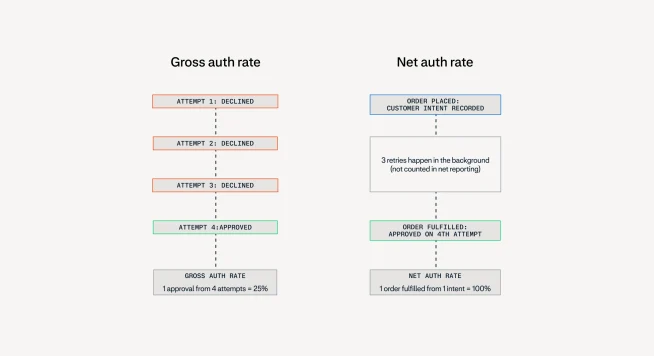
Gross auth rate counts every authorization attempt sent to the card issuer, including those that fail. If a transaction is attempted four times before it's approved, all four attempts are counted.
Net auth rate looks at whether the order was eventually authorized, regardless of how many attempts it took to get there.
For example: one transaction that fails three times before succeeding on the fourth attempt produces a 100% net auth rate but just a 25% gross auth rate.
When looking at overall figures, Provider A, who reports net auth rates, could be claiming an auth-rate average of 97.9%. Whereas Provider B, who reports gross, appears to come in much lower at 91.44%.
That 6.5% gap tells you less about Provider B's performance than it does about the retry volume sitting behind Provider A's headline figure.
Neither metric is wrong in isolation. Many businesses prefer to work from net rate as their primary metric, on the basis that what matters is whether the order was ultimately fulfilled. But if that's the case, it's important to understand the context behind it.
Even among providers that claim to report gross authorization rates, the calculation isn't always consistent. Some exclude online transactions blocked before they reach the issuer (by fraud detection tools, for example) which means the denominator itself varies.
Why a high acceptance rate can be expensive
Gross auth rate exposes retry activity in a way that net rate doesn't. For payment processors running high retry volumes to maintain strong headline acceptance rates, displaying that payment data can lead to uncomfortable questions. That's why understanding what sits behind your reported figures is important.
The true cost of a retry
Every retry incurs a processing fee regardless of whether the transaction ever reaches the card schemes. At a baseline of around $0.04 per attempt, the costs accumulate quickly. If your provider is retrying a transaction ten times before it succeeds, you're paying $0.40 to secure one sale.
This may not matter if your card payments tend to be low volume, high value. But for recurring payments or other high-frequency e-commerce transactions, costs can escalate rapidly.
Scheme retry penalties
In addition to the processing fee, retries that reach the card schemes might also trigger a formal penalty. The table below outlines Visa and Mastercard's penalty framework:
Gateway (PSP)
Rule
Per-attempt processing fee
Trigger
Every retry attempt, regardless of outcome
Penalty
~$0.04 per attempt
Visa
Rule
Hard declines (Category 1: closed accounts, stolen cards)
Trigger
From the first retry attempt
Penalty
$0.10–$0.25 per retry
Visa
Rule
Soft declines (Categories 2–4: e.g. insufficient funds)
Trigger
After 15–20 retries on the same card within 30 days
Penalty
$0.10–$0.25 per subsequent attempt
Mastercard
Rule
Transaction Processing Excellence (TPE)
Trigger
More than 10 declined attempts on the same card within 24 hours
Penalty
Up to $0.50 per retry
Mastercard
Rule
Merchant Advice Code violations
Trigger
Retrying after a MAC 03 (do not retry) or MAC 21 (payment cancelled) within 30 days
Penalty
Up to $0.50 per instance
Data compiled from official Visa Global Product and Service Rules and the Mastercard Transaction Processing Excellence (TPE) framework updates. Penalties reflect standard domestic baseline fees and recent card network pricing adjustments for non-compliant retry behavior.
These costs aren't always transparent. Failed transactions don't appear in your settlement file, so retry-related fees tend to accumulate and appear as a lump sum at month end rather than at transaction level.
A provider reporting a strong payment acceptance rate may be achieving it partly through retry volume that is eroding your margin in the background.
The difference between a retry strategy and a retry habit
Although retries come at a cost, that cost is usually worth it if the follow-up attempt is successful.
The problem is undifferentiated retrying. Blind retries send the same transaction repeatedly regardless of decline code, timing, or scheme rules.
A better approach is more targeted. Intelligent retries send transactions with a soft decline or insufficient funds code a day or two later when funds are more likely to have cleared. False declines (where a legitimate transaction is rejected in error) are also worth identifying separately, because these represent recoverable revenue that blind retry logic often mishandles.
Adyen's embedded suite of optimization tools, Adyen Uplift, uses smart logic to assess the refusal codes and determine if or when to retry. This helps to improve payment performance where improvement is possible, without driving up your costs unnecessarily for the sake of a good acceptance rate.
Adyen's solution: How gross reporting gives you the data to act
Adyen reports payment acceptance rate on a gross basis as standard, with full transparency regarding retries. Every message sent to a card issuer is counted and recorded, including failed attempts. A transaction that takes eleven attempts to approve is reported as eleven attempts, not tidied into a single success that hides the ten failures behind it.
Some businesses prefer to work from net rate as their primary metric. With Adyen, you get access to both, so you can understand what each is showing you and interrogate the retry activity sitting between the two numbers.
We treat gross data as a diagnostic tool
A gross authorization rate broken down by decline code lets you distinguish between different failure types: hard barriers like insufficient funds, technical failures like network timeouts, and authentication drops at the issuer level. Since we can see what the cause is, we can apply the right fix. For example:
A spike in insufficient funds declines could point to a timing issue that our Auto Rescue tool can address
A pattern of authentication failures could indicate a problem with how payment data is being passed to the issuer, which we can address by optimizing how that data is passed
Network timeouts could indicate a routing or connectivity issue within the payment infrastructure that Auto Rescue can fix
False declines can be identified by decline code pattern and escalated directly with the issuing bank
This kind of diagnostic work is harder when retry failures have been absorbed into a net figure. A gross rate with a clear pattern of failures in a specific decline category is something you can work with.
We apply the same transparency to our pricing
Many providers issue a single bundled invoice at month end, which makes it difficult to attribute costs to specific transactions or identify where retry-related fees are accumulating. Without that visibility, the true cost of a high net acceptance rate (and its impact on cash flow) can be hard to isolate.
Adyen's Interchange++ pricing model itemizes the components of every successful transaction separately: interchange, scheme fees, and Adyen's processing margin. So you can see exactly what you're being charged, and why.
Our questions that will tell you more than any headline rate
How useful payment acceptance rate is as a metric depends on how it's been calculated, what's been included in the denominator, and whether the retry activity sitting behind it has been made visible to you.
Before drawing any conclusions from a topline figure, it's worth asking your payment service provider these four direct questions:
Are you reporting gross or net?
What counts as an attempt in your calculation?
Where do retry-related fees appear on my invoice?
How do I reconcile them against my reported acceptance rate?
The answers will tell you more about your payment stack's actual performance than the headline number ever could.
If you'd like to learn more about our approach to reporting and how we can help you achieve better results from your payments, get in touch.