Article
One integration, global reach: Bringing UPI to Adyen’s single platform
Learn how Adyen integrates India's Unified Payments Interface (UPI) into its single global payment platform for seamless domestic and cross-border transactions.

The global payments landscape is a patchwork of legacy systems, local workarounds, and fragmented integrations. At Adyen, we’ve spent years dismantling that complexity to build a single, unified, financial services platform from the ground up.
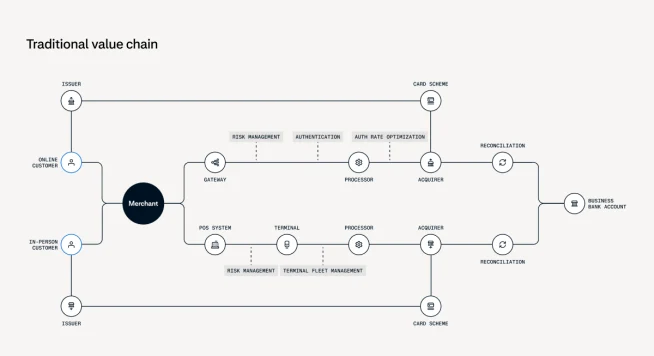
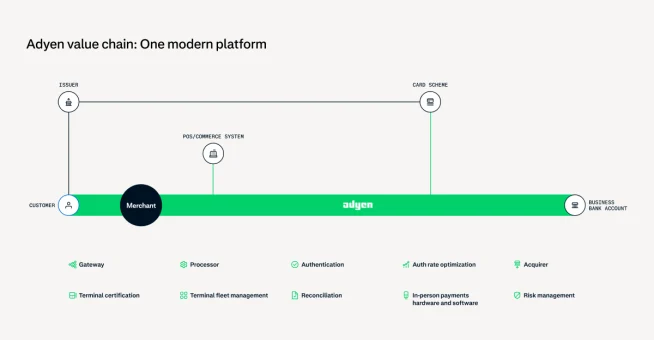
This "one platform" approach is what allows giants like Meta, Uber, and Microsoft to scale across continents without ever needing to integrate a new vendor. By managing the entire payment flow - from gateway to acquiring - we directly optimize authorization rates, reduce processing costs, and provide a unified view of customer data that is lost in a fragmented ecosystem.
Entering the Indian market presented an unique engineering challenge: the Unified Payments Interface (UPI). To understand the stakes of this integration, one must look at the numbers. UPI now handles 84% of all digital payments in India, processing over 20 billion transactions every single month. Built by the NPCI, this system offers instant, 24/7, free money transfers for 1.4 billion people, making it a world leader in making banking accessible to everyone.
Our main goal was to bring the world’s most advanced digital payment infrastructure to the world’s most dynamic market. UPI works by letting users link multiple bank accounts into one mobile app. It completely removes the old hassle of typing out long bank account numbers and routing codes, replacing them with the simple scan of a QR code or a quick link. To succeed here, any technological platform has to fit into this massive system.
Unifying UPI with global payments
Adyen’s payment platform is built to be global and standardized, supporting over 100 payment methods worldwide, including cards, digital wallets, BNPL solutions and direct bank transfers, while staying true to its “one platform” promise.
By unifying UPI’s complexities into our global API layer, we’ve eliminated the need for region-specific integrations. Merchants can now scale into India with minimal effort, using the same configurations and reporting they use worldwide. On Adyen, accepting UPI is now as seamless and standardized as any other major global payment method, like PayPal, Klarna, or Pix.
Why UPI is a “hard problem”
UPI isn't just another payment method to be “plugged in”. It presents architectural requirements that fall outside the typical global standards for payment processing.
1. Asynchronous state management
UPI is technically complex because it manages a multi-party ecosystem requiring precise state synchronization across an asynchronous, multi-step flow involving the merchant, PSP, NPCI, acquiring bank, and issuing banks. Unlike synchronous card transactions, the shopper-driven nature introduces unpredictable latencies where Additional Factor Authentication (AFA) must be validated at the device level, forcing the system to maintain high-concurrency integrity while handling frequent and long-duration "pending" states. This architecture demands robust reconciliation logic to ensure atomicity across disparate, distributed systems.
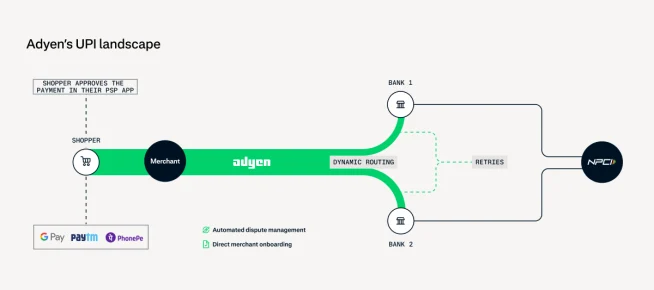
Adyen ensures UPI reliability through a multi-acquirer setup, providing built-in redundancy. Our smart retry mechanism automatically mitigates initiation failures, maximizing success rates across a resilient, distributed infrastructure.
2. The golden rule: no broken contracts
Adyen’s core promise is "Build once, accept payments anywhere." This means we can’t simply spin up a new "India-only" API. We must fit the complexity of UPI into existing API contracts that thousands of global merchants already use, while accounting for regional compliance and regulatory mandates. Backward compatibility isn't a "nice-to-have”, it’s a hard constraint.
3. Automation vs. manual intervention
In India, the industry often relies on manual touch points for tasks such as dispute resolution or reconciliation. Adyen’s global customers expect zero-touch automation. To address the idiosyncrasies of Indian banking, Adyen replaced manual, error-prone email chains between banks and merchants with a streamlined API and webhook-driven dispute management system. By digitizing handwritten notifications and enforcing structured workflows, the platform minimizes the risk of missed Turnaround Times (TAT) and financial loss caused by lost correspondence. This shift transforms a fragmented, human-dependent process into a global-standard automated experience, requiring both technical integration and a fundamental shift in ecosystem behavior.
4. Powering subscription payments
UPI AutoPay is an entirely different ballgame, introducing multiple additional steps (both synchronous and asynchronous) that differ from the global Local Payment Method (LPM) token model. For example, the first charge on any mandate must be executed within a strict five-minute window of registration, and shoppers must be notified at least 24 hours before any subsequent recurring charge. Furthermore, the merchant is no longer the sole controller of the subscription; shoppers can pause or revoke mandates directly within their own banking apps.
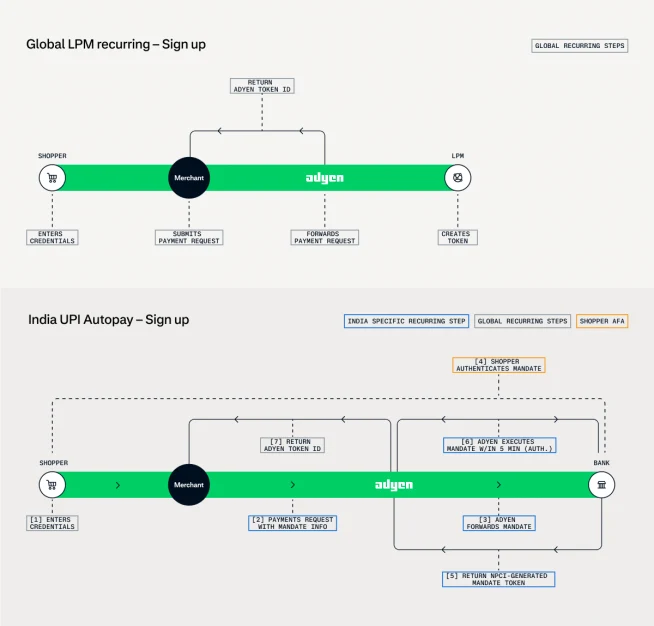
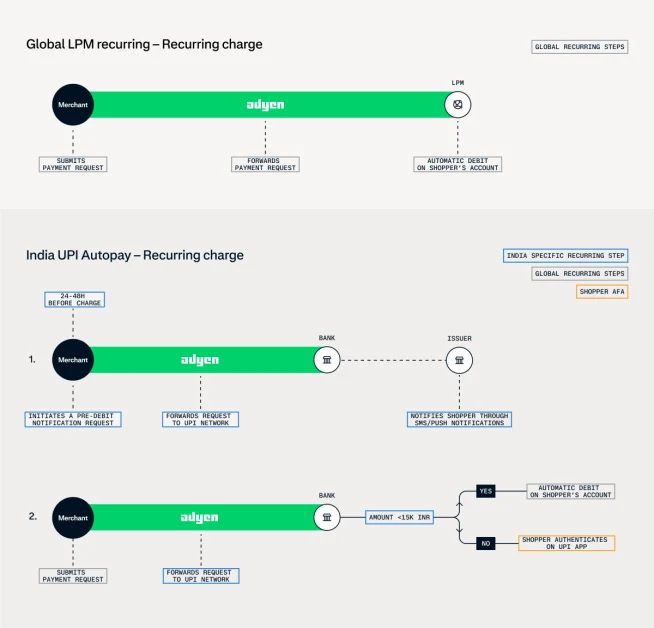
Adyen manages these complexities without fragmenting our standardized global API. We maintain a consistent merchant experience by handling mandate registration and the initial charge as a single, unified flow. To meet notification requirements, we exposed a dedicated pre-debit endpoint that allows merchants to trigger shopper alerts via a simple API call. Finally, we use partner webhooks to ingest shopper-led revocations, ensuring the merchant’s system stays synchronized with the mandate’s status in real time. Ultimately, these workflows seamlessly abstract away local regulatory nuances, shielding merchants from underlying complexities.
Why this is a fascinating engineering challenge
It’s easy to build without constraints. It’s incredibly difficult and rewarding to build within them. Building UPI at Adyen isn't just about payments in India; it's about defining how the world interacts with the future of Indian fintech.
While coding at Adyen, we are solving for:
Extreme Scale: During global peaks like Black Friday and Cyber Monday, our platform manages an immense load, recently reaching a total processed volume of €1.39 trillion in 2025, with systems designed to handle thousands of transactions per second (TPS). Over the BCFM weekend , Adyen processed 670 million transactions with 99.9999% uptime. Our UPI integration must be as resilient and performant as our core global engine.
Fault Tolerance: We work with multi-region systems where data consistency and five- nines availability guarantee are non-negotiable requirements for the world’s largest merchants.
Cross-Market Reuse: We learn to identify which parts of a payment flow are "market-specific" and which can be abstracted into global capabilities, such as the “Validate ShopperID” feature, which was originally built to verify UPI VPAs in India was repurposed to verify shopper’s PayID for PayTo in Australia. By recognizing these patterns, we stop building one-off solutions and start building a scalable global toolkit.
While many engineering roles focus on solving for a single market in isolation, Adyen challenges us to think bigger. We aren't just building for one region; we are architecting the financial backbone for the global economy, ensuring that a localized innovation today becomes a global standard tomorrow.