Article
This is Adyen: Catherine Ye, SVP Engineering
Meet Catherine Ye, SVP of Engineering for Financial Products at Adyen. Learn about the evolution of her career and why talking straight is key to solving complex problems in fintech.
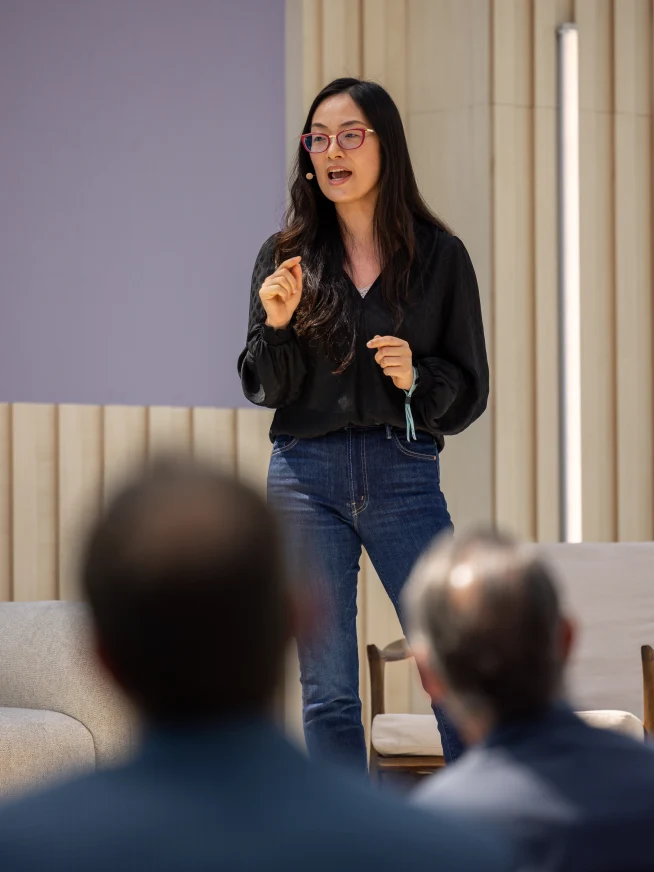
As SVP of Engineering for Adyen's Financial Products, Catherine Ye leads the teams that build and scale the infrastructure that connects our single platform to central banks and powers products like Bank Accounts, Issuing, Capital, and enable end-to-end money flows needed by businesses globally.
We sat down with Catherine to discuss the evolution of her career and leadership style, and why a culture of high trust and talking straight is key to solving complex problems in fintech.
Could you share a little bit about your career so far and what led you to Adyen?
The short version is that I spent over half of my 20-year career at Google, another good amount at Stripe, and the most recent year at Adyen. What's interesting to me is how differently each one shaped who I am today.
At Google, I lived an engineering-centered life. When I finally stepped out of it, I realized I had been in a bubble for almost 13 years without knowing it. Google was known as an engineering first company from its early days. Everything was built around engineering and technology.
What I learned from this phase was invaluable. I worked with distributed systems, cloud services, data processing, computing infrastructure at the largest scale in the world, surrounded by extraordinarily talented people who constantly humbled me. I learned how to engineer at scale and do it smartly. We were obsessed with the load, latency, P99s, P99.9s, all the geeky stuff. It taught me real technical depth.
At some point, I got bored. I started seeing the same patterns of technical problems show up in different shapes and contexts. I wanted new challenges that I have not done before. In my move to Stripe, I went from an engineering-centric life to almost the opposite. I had to push myself to think from the business, finance, product, and customer angles. That shift was a huge learning opportunity, it changed my mindset from making engineering decisions for engineering, to making engineering decisions for businesses.
That experience then led me to Adyen, where I got to bring both of those mindsets together.
How would you describe your leadership style and philosophy?
I’m an outcome-driven leader. At the end of the day, we all work for a business, and if we can’t deliver the business outcome, there is no real point to my job. Underneath that, the question is always how do you get to the outcome, and how do you get there in a productive and effective way? That leads to a few things I believe in.
First, a high-trust environment matters a lot. My team, and others I work with, need to truly trust each other to speak our minds, especially when the topic is spicy, or the opinion is uncomfortable. I've been in plenty of situations where that trust wasn’t there; no one felt safe naming the elephant in the room. If you can't name it, you can't resolve it.
The other piece of my leadership philosophy is about self-motivation and agency. Self-motivation shows up when people work on things they actually believe in and feel passionate about. Part of my job is helping people understand where we are going, why we are working on something, why the problem matters, what could be possible, and seeing if that clicks for them. When that click happens, they wake up feeling energized and ready to go every morning. That’s how you get intrinsically energetic, engaged, productive teams who produce great results.
Lastly, I believe that leadership is a two way street. Being a leader doesn’t make me the smartest person in the room. While sometimes telling people what to do may seem the easiest option, it doesn’t always help enable the person on the receiving end with their agency. I learned to control my urge to spit out an answer to a problem, and instead to cultivate discussions where we challenge each other’s thoughts to reach better answers, coming from a group of intelligent people, not just a single one.
You mentioned that direct communication shapes your leadership style. Has that always been your approach, or did it evolve?
It has not always been the case for me. I went through a journey myself. If I reflect on the first couple of years of being a manager versus today, there are pretty noticeable differences in how I lead and manage.
When I first became a manager, I worried about my relationship with the team members. I worried about whether they’d listen to me. I worried about their experience working on the team. As a result, I tended to be a people pleaser.
Over time, through many conversations and data points, I realized that people aren’t looking for a people-pleaser as their manager. They want clarity; they want feedback; they want to grow. They want to know what matters, what they need to work on, what their leaders are thinking, and what changes they need to make in order to build their career.
Through practice, I learned that I can build a lot more trust with people, not by pleasing them, but rather by bringing clarity, my authentic suggestions and feedback. Over time, I got more and more positive reinforcement from a wide range of people and context I’ve worked with, which influenced how I lead in a big way.
That philosophy is aligned with the Adyen Formula point of “we talk straight without being rude”. Can you talk about how that shows up at Adyen?
Imagine a world where it's, "Because Catherine said so, we have to do it, even if I don't agree." In that world, we'd not land on the best decision consistently. I’m not always the smartest in the room, nor can I possibly know everything happening across a large organization. That's why I value a culture where we can speak our minds and be honest with each other.
"I don't agree yet, but let's figure out where we differ and how to solve it." It's direct and efficient, but never rude. We genuinely like each other and have great working relationships. That directness is something I really appreciate about our culture.
I see this in different settings too, sitting in a meeting with the management board, with peer leaders, with cross-functional teams I was meeting for the first time. People will say, respectfully, “I’m going to challenge that a little bit” or “let’s pressure test this.” And the follow-up conversation from there is usually constructive instead of defensive. I think that’s a treasure in our culture that we need to hold onto very dearly.
The directness, combined with the level of humbleness I’ve come across in almost everyone here, is rare. I think that’s what makes Adyen a great place to work.
What excites you most about working in FinTech, and has that changed over time?
I believe the real game-changing stuff in Financial Service is going to happen within the next decade or so, and it’s up to us to make the innovation happen!
I am extremely fortunate to have Google as the introduction into the professional world back in 2006. The mindset that technology can change the world in big ways has been ingrained in my mind. As consumers, we’ve lived a fascinating 20 years to witness and experience smart phones, video streaming, on-demand economy, and so on. In the B2B world, vertical SaaS has been applying technology to each vertical industry and changing how traditionally labor-or-operational heavy work is done.
While meaningful progress has been made on how financial services work, the real game-changing evolution has yet to come. It’s a very complex industry with heavy regulation and high complexity baked in across systems designed more than fifty years ago, in addition every country has its own regulatory requirements as well as user habits. However, I believe it’s inevitable that how money is moved and managed will substantially change over the next decade with technology.
Another thing that interests me is that while the last (or rather current) wave of financial technology is still happening, the next wave is already here: AI. The latest development enables us to solve some of the problems in a non-conventional, non-labor-intensive way. For example, many financial services rely on documents that come in highly variable format, terminology, as well as languages. Instead of heavily relying on human reviewers, we now can use teams of agents to handle these problems. Fintech innovation combined with the AI transformation makes it both more challenging and exciting at the same time.
What principles guide technology upgrades and evolution at Adyen, and how are those decisions made?
Adyen encourages high autonomy for our people. Our engineers see a problem, identify the need, and oftentimes come back with proposals. Depending on the nature of the problem, the team usually figures out the key stakeholders they need to work with to evaluate options.
A good recent example is choosing AI dev tools. There are many options, such as a single-provider-single-model approach, or multi-provider, or a gateway approach. To make that choice, we first established the principles to structure this decision, i.e., do we need to preserve optionality among model providers? Then we ran pilots internally, got engineers to try out some of these tools and report back on what’s working, what’s not, and what they’d ask for. That feedback, almost like customer feedback to our own products, feeds into the final decision.
What does success look like for your team, both in product terms and culturally?
Culturally, in a B2B business, our success has to be obsessed with customer happiness and success, which to a great extent is reflected in our product and business metrics. We need to live that customer obsession to build the right thing, ship it, and ship it at the right quality. Product success is deeply rooted in adoption, usage, and in customer feedback on quality and usefulness.
In addition, there is an inward oriented view on the success of an organization, which is deeply rooted in the engagement and agency of its people. The more engaged people are, and the more agency they take, to an organized and shared direction, the more it indicates a productive and highly functioning team.

How would you describe an ideal candidate for your team?
I believe that to build a capable, high-functioning team that thrives for the long term, one needs a diverse set of people who complement each other.
That said, the common traits I look for are curiosity and humbleness. After working on some of these for years, I still get educated by people on a regular basis, whether it’s about a Visa spec, a regulatory constraint, or user habits in a particular country. Curiosity helps us learn faster, but more importantly be open minded to what others think of a topic and the willingness to work together to solve a problem.
Beyond that, there’s critical thinking and high agency, the ability to identify problems and solve them, not because you were told to, but rather you see the need based on first principle reasoning and come to the conclusion on what’s the right thing to do and take action on it.
Coming back to the point of complementary talent. Some people are great communicators who love working with people, while others may be more introverted. Some care more about solving system problems, making something scale or run faster, while others deeply care about the journey and interface for a customer. Nobody is good at everything. Having a complementary group of talent is essential to achieve “one plus one greater than two” result.
Do you have a key piece of career advice you'd like to share with engineers?
I always encourage people to pop their head up, look around, and look beyond what’s immediately in front of them. What are your peer team members working on? What are your neighboring teams working on? What’s a partner function working on? Building that context and knowledge matters because, at the end of the day, your individual work reflects in that bigger picture.
So don’t stay in your lane heads down all the time; broaden your visibility, exposure, and knowledge across the product, domain, tech systems that you work in.
—
Ambitious? So are we. Build the future of fintech with Catherine and explore open tech roles in San Francisco, North America, and across our global offices.
