Article
Accepting payments with a payment gateway explained
Dive deeper into the world of payments and get a better understanding of payment gateways. Discover the most important things to consider when choosing one for your business.

Being able to fully understand the payment flow is an essential first step to make it work in favour of your business. We know that the payments flow may seem complex, with multiple steps and parties - which is why we’re here to help.
In this article, we'll focus on the very first step of the payment flow: the payment gateway. After reading it, you'll be able to fully understand what a payment gateway is, what to consider when choosing one for your business in Australia and the positive impacts of a payment gateway built on a single platform.
What is a payment gateway?
The very first step of a payment flow, the payment gateway is a service that helps businesses initiate payments. Used in both digital channels and in-person, the payment gateway is typically a web server to which businesses are connected.
You can either choose a payment gateway that is provided by a bank or one from a provider that can connect to one or more payment processors.
Types of payment gateways providers in Australia
Different types of business have different needs - the same applies when it comes to payment gateways.
Online payment gateways provide services for websites and apps. They typically have the same function (initiating payments), but can differ in term of functionalities, supported channels of features offered. To obtain the maximum benefits from a payment gateway, it’s essential to understand your business needs and choose one that works best for you.
One example on how specific needs may shape your payment gateway choice: a subscription business needs a gateway that supports recurring payments; but SaaS or marketplaces might require one that can offer embedded payments. Ecommerce companies may opt for a payment gateway that offer many fraud detection and prevention tools. High-risk industries, such as airlines or gambling, may need a payment gateway with a high-risk appetite.
The payment gateway in the transaction flow
During the few seconds that a payment takes to be completed, a whole universe is happening behind the scenes. Below you can visualise the whole transaction flow. Remember, this flow begins with the payment gateway.
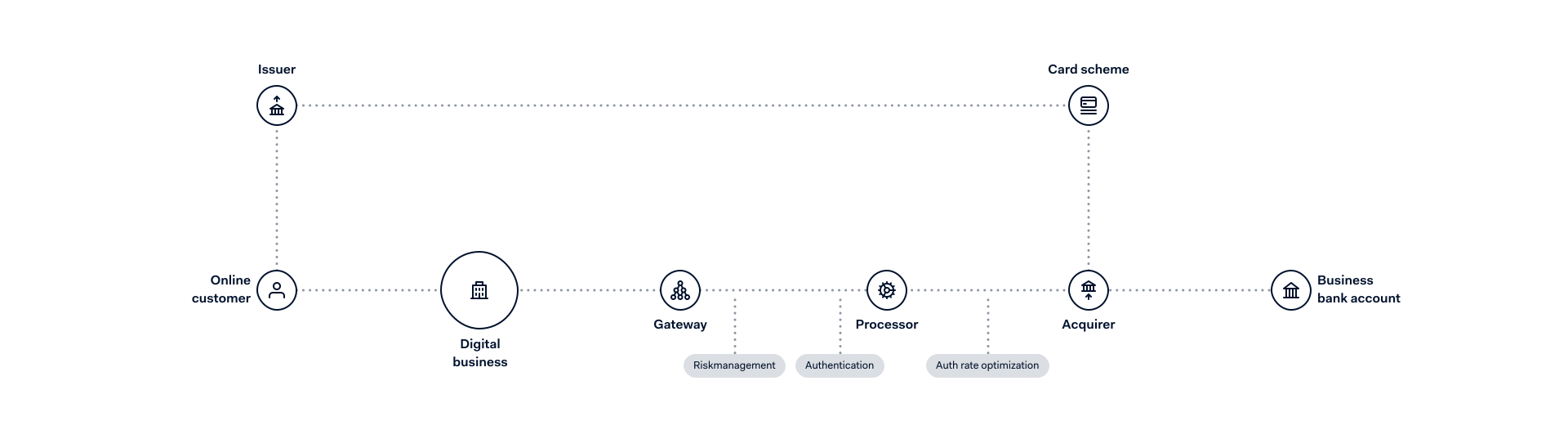
How the payments flow, in simple terms:
When a customer makes a purchase, the business sends the customer's payment data to the payment gateway.
Then, the payment gateway shares the data with the payment processor, who in turn will share the same information with the card scheme.
The card scheme shares it with the card issuer, which performs checks to determine if the transaction should be authorised or declined.
The decision regarding the transaction flows back through the card scheme, payment processor, and gateway to both the business and customer.
If the payment is approved, the funds move from the customer's bank to the acquirer and then to the business's bank account.
So how does a payment gateway work? In simple terms, it securely transmits payment data between the customer, the merchant, and the banks involved in the transaction, ensuring the payment is authorised and processed safely.
Choosing the best payment gateway
When deciding which payment gateway to use, businesses should consider factors like supported payment methods, security standards, global coverage, and how easily the gateway integrates with their existing systems.
Pricing
There are several pricing models in the payment gateway market. Saving costs is often a priority for many businesses. Choosing a gateway with a pricing model that suits your business needs is a very important step.
Some suppliers charge a percentage-based fee, others a fixed fee per transaction. If your business has a high Average Transaction Value (ATV), a fixed fee could be more cost-effective.
It is also important to remember that some gateways will charge one-off costs, for setup or integration fees. They might also offer services like 3D Secure, risk management, or authorisation optimisation, which may affect the cost but add value to your business.

Security and compliance
Keeping your customers and their information safe should be a priority to your business. Payment gateways hold specific certificates and conform to measures to protect payment information. The ones you should expect are:
Payment Card Industry Data Security Standard (PCI): This is crucial for businesses that accept credit card payments. Businesses must adhere to 12 security standards when handling credit card data, including accepting, transmitting, processing, and storing it.
Compliance with applicable privacy laws
For businesses that accept payments in Europe, it’s important to follow these regulations too:
Payment Services Directive 3 (PSD3): This regulation pertains to payment authentication. However, it hasn't been implemented yet, which means that Payment Services Directive 2 (PSD2) and Strong Customer Authentication (SCA) still apply.
General Data Protection Regulation (GDPR): This regulation ensures that personal data is only used for purposes for which the customer has consented.
International payments
Before accepting international payments, your business must ensure that your payment gateway supports it. There are different ways of accepting international payments, like cross-border transactions or local acquiring, which tends to offer higher authorisation rates.
Offering your customer's preferred payment methods is also important. Therefore, it is essential that your payment gateway can support relevant payment methods, so you don't end up with a high rate of abandoned shopping carts and disappointed customers.
Differences between regulations between countries are also relevant. While Australia has specific rules on authentication, in Japan, new 3DS regulations will be implemented by 2025. The payment gateway of your choice should comply with local regulations where you plan to accept payments.
Differences between a payment gateway and a payment processor
‘Payment processor’ and ‘payment gateway’ are two players of this ecosystem that often get confused with each other.
At this point, you hopefully understand what a payment gateway does: it helps businesses initiate payments.
A payment processor, in turn, processes payments on behalf of a business’s bank. It operates in the background, making sure processed payments comply with local rules and standards.
After receiving information from a payment gateway, the payment processor communicates it directly to the payment network and authorises, clears and captures the transaction.
Do you recall the payment flow we shared earlier in this article? The first step is done by the payment gateway, by gathering data and passing it forward. The payment processor is the player that receives this data in the next step, then contacts the card schemes and business' bank to approve that payment.
A payment gateway and payment processor can be two separate systems. However, having both on a single platform can increase the efficiency and reliability of the payment process.
Simplify your payments funnel with Adyen
A payment gateway is a foundational component of modern digital payments. For enterprise teams, the best payment gateway choice is the one that balances performance, security, and the flexibility to scale globally without multiplying complexity.
At Adyen, we combine a payment gateway, acquirer, and processor into one platform. Our enterprise payment gateways are purpose-built to handle trillions of transactions all over the world. Some of the largest companies in the world trust us to handle their payments, including businesses like Nord Security, Adobe, and others.
Ready to consolidate your payments into one unified platform that helps you save money and grow revenue? Learn more about what it means to accept payments with Adyen, or contact our team to get started.
Frequently asked questions about payment gateways
An ecommerce payment gateway is a payment gateway designed for online stores. It is a payment gateway for your website or mobile app that accepts digital payments at checkout, routes transactions for authorization, and supports security controls that help protect customer data. Learn more about ecommerce payment processing.