Article
What are chargebacks and how to prevent them
Learn what a chargeback is, how the process works, and ways you can avoid them.

Chargebacks were introduced to offer consumers an easy way to dispute suspicious transactions and to protect them from payment fraud. But for businesses, chargebacks can put revenue at risk, especially as friendly fraud becomes more common.
Although chargebacks are a part of doing business (and a good sign that your risk management strategy isn't overly strict), there are ways to reduce them.
This article will explore what chargebacks are, how the process works, and ways you can prevent and respond to them.
What’s a chargeback?
A chargeback is when a payment is reversed after a customer disputes a charge on their account statement.
For example:
The customer might have received a damaged product. Or maybe the merchant made a processing error and accidentally charged the customer twice. In these cases, a customer can file a chargeback with their bank for transactions made on credit or debit cards.
Once approved, the customer receives the transaction amount back in full. But if the merchant disagrees with the chargeback claim, they have the chance to defend it.
Chargebacks vs. refunds
Although chargebacks and refunds both involve the return of funds, they’re very different.
Mostly, customers can ask for a refund directly from the merchant within their refund policy. But sometimes, the merchant might reject the refund request.
Maybe the merchant claims the product wasn’t damaged on arrival or believes the package was actually delivered on time. If there’s a difference in opinion, the customer may request a chargeback.
With a chargeback, the customer contacts the bank (not the business) to reverse the payment. The chargeback process takes longer and involves a few more stages than a refund. And any fees associated with a chargeback are significantly higher than a refund.
How do chargebacks work?
The chargeback process differs depending on the payment provider. On a basic level, a customer requests a chargeback and the bank validates it. Funds are taken from the merchant’s account and then returned to the customer. After this happens, the merchant may dispute the chargeback.
In a bit more detail, it usually looks like this:
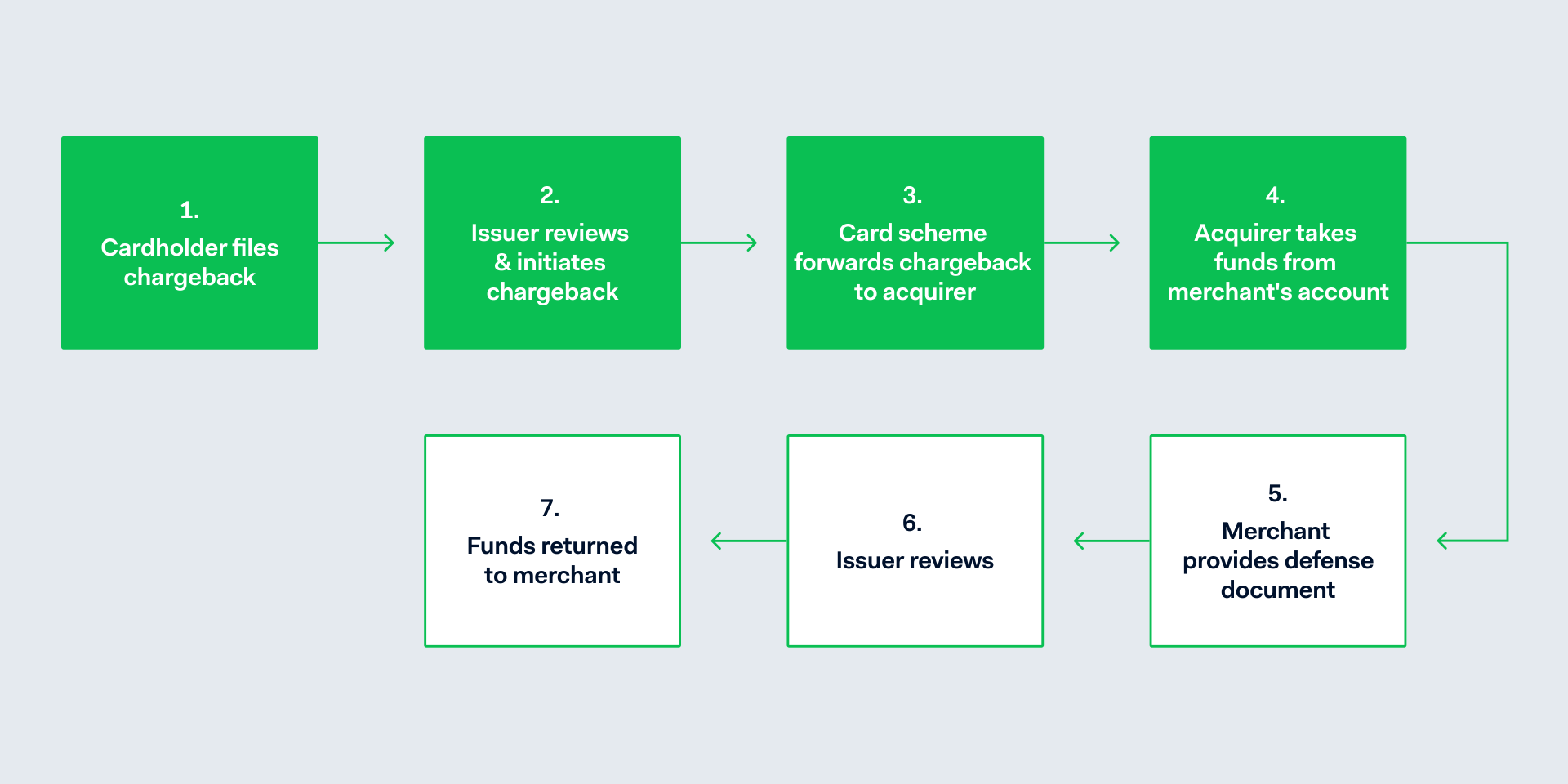
The cardholder files a chargeback via their bank. They usually have up to 120 days after purchase to dispute a charge, though some card schemes allow up to 365 days.
The issuer reviews the case, assigns a reason code, and initiates the chargeback.
The card scheme receives the chargeback and forwards it to the acquirer.
The acquirer receives the chargeback and debits the funds from the merchant’s account. The acquirer also charges the merchant a fee ranging between $5-100.
The merchant reviews the chargeback and provides a defence document if they choose to challenge it. They must defend the chargeback within 14-40 days (see specific time frames per scheme here). The acquirer forwards the merchant decision through the scheme to the issuer.
The issuer reviews the defence document and decides to accept or decline.
If the issuer accepts the defence, the acquirer returns the funds to the merchant.
If the issuer declines the merchant’s defence, they can argue against it. This is called a second chargeback, which is usually refused.
If the issuer declines the second chargeback, you can go through a third round, called arbitration. Arbitration is often not advised as the fees are particularly high (up to $500 on top of the disputed amount).
Reasons for chargebacks
When the issuer approves the chargeback from the cardholder, they assign a reason code. Each card scheme has a different set of reason codes, but they all fall into one of the following groups:
Fraud
The cardholder claims they didn’t make or authorize the transaction.
Consumer disputes
The product wasn’t as described or didn’t arrive by the expected delivery date. Or the cardholder was informed the payment wasn’t processed.
Processing errors
Some of the payment information was incorrect. This could include information like the amount, currency, or account number.
Authorization
The payment couldn’t be authorized, or the authorization was declined.
How to prevent chargebacks
Chargebacks can cost businesses both the purchase amount as well as additional fees. Banks and card networks may also penalize you if your chargeback ratio (the percentage of chargebacks of your transactions) becomes too high.
Preventing chargebacks is more important than defending them. Even if you win the chargeback defense, it’ll still count against your chargeback ratio.
Although you can't avoid chargebacks altogether, there are ways to lower the amount. Here’s what to focus on:
Make returns easy
Refund as quickly as possible when the customer requests one
Have a clear returns policy
Provide your email address and phone number on your website and emails so that the customer can easily contact you
Get the goods to the customer on time
Set a realistic delivery date. If there are delays, let the customer know as soon as possible.
Refund customers proactively if you can't provide the goods/services by the expected delivery date
Track your goods to monitor their delivery date. Ask the customer to sign for the package on delivery for extra security.
Avoid any miscommunication
Ensure the payment descriptor of your bank account is clear and accurate
Respond to any customer questions quickly
Alert your customers if a product is out of stock as soon as possible
Provide detailed product descriptions on your website
Prevent fraud
Use authentication tools like Address Verification Service (AVS), card security codes (CVV), and 3D Secure 2
Make sure your risk system can identify customers who regularly file a chargeback and could be committing friendly fraud
How to dispute chargebacks
After a chargeback is initiated, you’ll receive a Notification of Chargeback (NoC). From this point, you can choose to defend the chargeback within 14-40 days (see the exact time frame per card scheme).
Start by reviewing the case and the reason code to understand why you received the chargeback and if it’s worth disputing.
When is it worth disputing a chargeback? Build a case with as much evidence as possible . Try to collect all your interactions with the customer to help disprove the chargeback claim.
For instance, if the cardholder claims they didn’t take part in a transaction, you could provide:
You think the transaction is legitimate
Don't dispute
You know the transaction is fraudulent
The transaction amount is considerable
Don't dispute
The transaction amount is low
Build a case with as much evidence as possible. Try to collect all your interactions with the customer to help disprove the chargeback claim.
For instance, if the cardholder claims they didn’t take part in a transaction, you could provide:
evidence of their previous undisputed purchases
proof of delivery at the cardholder’s address
or any contact they’ve had with your customer service team
Some payment providers, like Adyen, will automatically defend chargebacks if the case is straightforward. For example, if you’ve already refunded a transaction before the cardholder filed for the chargeback, Adyen’s auto-defense feature will defend it with no action needed on your part.
Once you’ve submitted the defense, the card issuer will either accept or decline it.
How Adyen helps enterprise businesses prevent chargebacks
Our solution is built on the premise that you shouldn't have to choose between reducing chargebacks and protecting conversion. Because Adyen operates across the full payment stack, from authentication through to settlement and dispute management, it has access to data that a standalone tool simply cannot see. This includes cross-merchant data from the thousands of businesses processing on the Adyen platform, which means our models are trained on a breadth and depth of transaction data that is difficult to replicate.
Here’s what you can expect when you work with us:
Act before a dispute is filed by identifying high-risk transactions in advance
The most effective chargeback prevention happens before a dispute is filed. We use machine learning trained on platform-wide data to identify high-risk transactions before they become disputes. This means you can block the transactions most likely to result in a chargeback without disrupting the experience for legitimate customers.
For fraud-related chargebacks, 3D Secure authentication automatically shifts liability to the issuing bank, meaning that even if a chargeback is filed, your business is not liable for the disputed amount and it shouldn’t count against your fraud ratio.
This means you can block the transactions most likely to result in a chargeback without disrupting the experience for legitimate customers.
Reduce the operational burden without relinquishing control
Many businesses still rely heavily on rules-based fraud systems: spotting a spike in chargebacks, analyzing the data, identifying common patterns, and writing a rule to address it. The problem, as Merlin's Head of Global Payment Risk put it, is that "by the time these were implemented, fraud tactics had changed again."
We replace that reactive cycle with machine learning that adapts continuously. That doesn't mean removing human control entirely. Configurable rules still give your team oversight over edge cases, seasonal peaks, and business-specific nuances. But the ML does the heavy lifting, reducing the operational overhead of managing disputes and freeing your team to focus on decisions that actually need human judgment.
See the full picture, across every channel and market
Chargeback management becomes even harder when your fraud tooling can't connect data across channels or regions. A customer who shops in-store and disputes online, or who has a history of chargebacks across different payment methods, looks very different depending on what data you can see. Because we process payments across online and in-person channels in all key markets, we can help you build a more complete picture of each customer's behavior across every touchpoint and region.
How Adyen helped Hunter reduce chargebacks by 90%
Hunter is a good example of what's possible when chargeback prevention is treated as part of a broader payments strategy rather than a standalone problem. When Hunter moved to Adyen, they included their risk challenges in the RFP and worked with our team to build a concrete plan for reducing chargebacks year-on-year with clear KPIs. The result was a chargeback rate reduction from 2% to 0.2%, a 90% drop overall, achieved without compromising authorization rates. Read the full Hunter case study
Hunter's experience is consistent with what a recent Forrester Total Economic Impact™ study found. By partnering with a unified solution like Adyen that offers in-built fraud prevention tools, businesses can reduce chargebacks by 27%, worth $2.5 million over three years
Managing chargebacks starts with connected data
Chargeback rates rarely improve without a clearer picture of what's driving them. Visibility into where chargebacks are actually coming from, and the ability to act before a dispute is filed rather than after, is what separates businesses that manage chargebacks well from those that don't.
That means having the right data, the right tooling, and a clear view of what your chargeback rate is actually telling you across channels, markets, and fraud types.
If you'd like to explore how Adyen can help you reduce chargebacks without compromising conversion, get in touch with our team.
Chargebacks FAQ
A refund is issued by the business at the customer's request. A chargeback is initiated by the cardholder through their bank, which reverses the payment and notifies the business after the fact. With a refund, the business retains control of the process and avoids the fees and dispute overhead that come with a formal chargeback. With a chargeback, the bank decides the outcome and the business pays a fee regardless of whether the dispute is upheld.