
Reports
Delegated Authentication: Less friction, higher conversion, better authentication
Here's how delegated authentication works, and what it can do for your online payments.
As the digital economy grows, so does the pressure to verify customers and keep fraud out, without letting conversion rates slip in the process.
Strong Customer Authentication (SCA) requirements help solve this by cutting down on fraudulent transactions. In the UK, SCA has been mandatory since 2022, enforced by the FCA under the Payment Services Regulations, with equivalent rules in force across the EU and parts of APAC, including India, Australia, and Malaysia.
Handled poorly, though, authentication introduces friction into the payment process, and that friction hits customer experience and conversion rates alike. It tends to happen when security is treated as the only priority, with customer experience left as an afterthought.
Delegated authentication has become one of the go-to answers, particularly for returning customers, helping businesses deliver an experience that's both safe and seamless, while lifting conversion rates along the way.
Defining delegated authentication
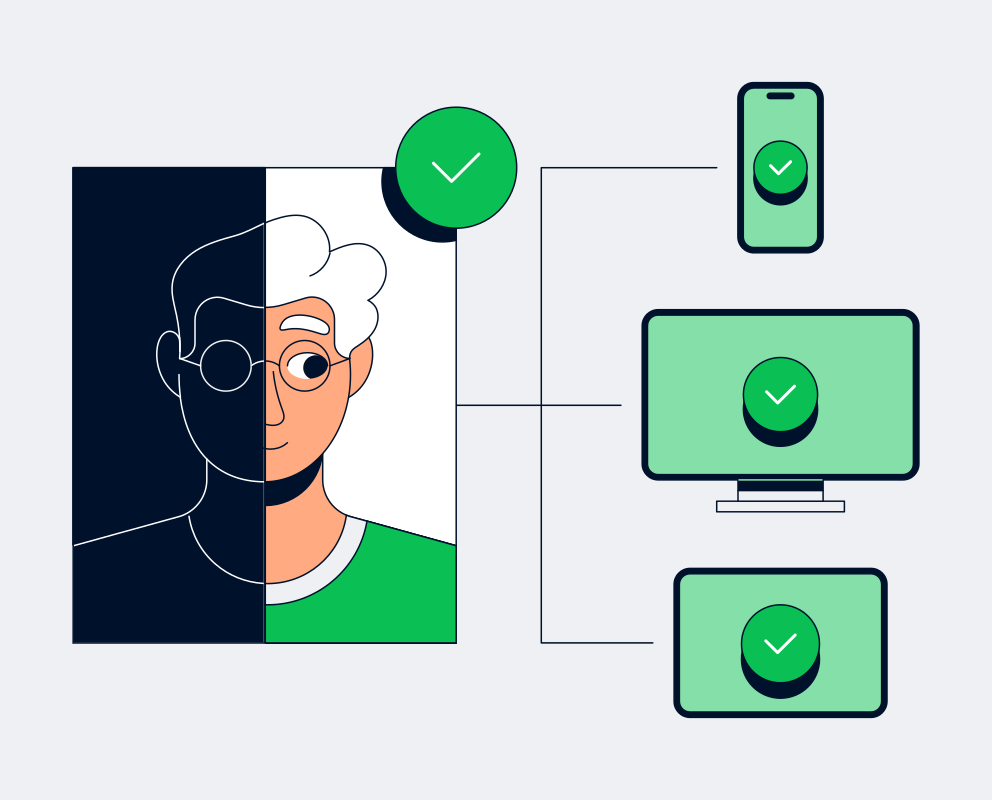
Delegated authentication is when you let another party manage the authentication process. An external platform verifies the user’s login credentials and can link and recognise their identity across many different systems. One example of this is single sign-on (SSO), which allows users to access multiple systems with a single ID.
How delegated authentication fits into payments
Three parties are involved in the payment authentication process: the issuer, the acquirer, and the card schemes. The issuer is the customer’s bank, which manages the authentication process. The acquirer sends the relevant payment information to the issuer so that it can verify the transaction. In some cases, the acquirer is also the business’s payment service provider. Schemes are responsible for generating and validating the proof of authentication together with the issuer.
With delegated authentication, the authentication that the issuer usually performs is passed over to the acquirer. This allows the acquirer to control the process and its quality, improving the experience and reducing friction.
What delegated authentication can do for you
Delegated authentication is one way to increase security while improving the authentication experience. This results in higher conversion rates while reducing fraud.
Here are some of the benefits:
Reduce drop-off rates
Increase conversion
Provide a seamless experience
Reduce fraud with a secure authentication process
Reduce latency
How the process works
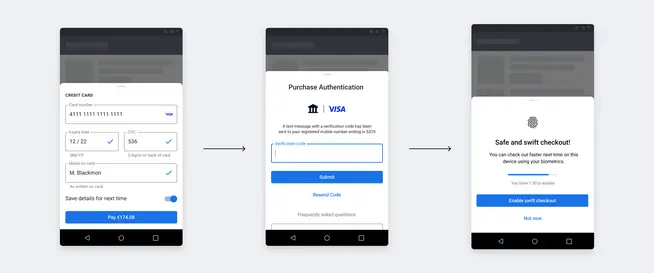
The process can differ depending on whether you’re a first-time or recurring user.
Enrolling first-time users:
Enter card details.
Connect the card by verifying through 3D Secure.
Connect the device by verifying through delegated authentication (using biometrics).
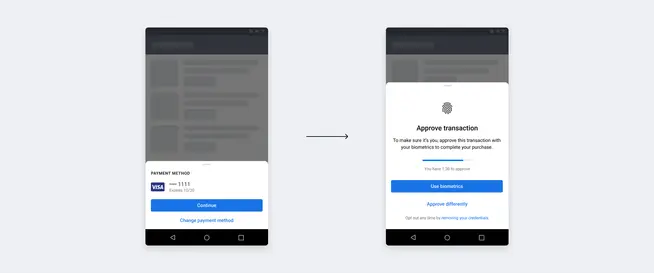
Authenticating recurring users:
Choose the option “use stored card details.”
Verify through delegated authentication (using biometrics).
Cutting friction with delegated authentication
At Adyen, we combine the security aspect with the customer experience to optimise the overall authentication process and increase conversion. This creates a balance between convenience and security.
Delegated Authentication is a feature that’s part of our authentication solution. It allows us to fully authenticate the customer on behalf of the issuer, providing a seamless cardholder experience. By controlling this process, we can preserve the standard of our online payment experiences and keep customers on the checkout page. We can recognise already-authenticated customers and provide them with a better experience, which reduces drop-offs.
Delegated Authentication technology is provided in regions where SCA is mandated by the Payment Services Directive 2 (PSD2).
Ready to take your authentication experience to the next level? Learn more here.