Article
Banking as a service: What is it and how to select the right provider?
Discover what banking as a service (BaaS) is, how it enables platforms to meet the financial needs of small and medium-sized businesses, and how it can drive revenue and loyalty.

The financial landscape has shifted for small and medium-sized businesses (SMBs) thanks to platforms and marketplaces. Without the necessity to become a bank, they are able to offer their SMB users financial services and support themselves thanks to banking as a service (BaaS).
With BaaS, platforms can integrate financial services into their offerings - something which is in high demand. 64% of SMBs in 2022 alone wanted platforms to offer business accounts, cash advances, and issued cards rather than turning to banks.
Rather than taking the one-size-fits-all approach often adopted by banks, which isn't well suited for lower margin SMBs, platforms can cater to their dynamic needs with BaaS. And they’re better equipped to do so. They can leverage the relationships they’ve already nurtured with their SMB users and their in-depth understanding of user challenges to deliver highly tailored and efficient solutions.
Banking as a service: What is it?
BaaS is a financial technology solution that lets non-bank businesses, like platforms and marketplaces, directly offer services traditionally restricted to licensed banks. These include business accounts, cards, and loans.
BaaS providers facilitate this setup. How? By supplying the core technology stack and licences needed to offer banking services, and embedding them into a business’s key offering, brand, and existing interface. On top of this they cover compliance, risk, and know-your-customer (KYC) requirements.
How does BaaS work for platforms?
With BaaS platforms can broaden their offering, embedding financial services effortlessly into the processes they already facilitate for SMBs, creating a single interface for users to manage all their business operations. While their BaaS provider oversees the banking technology and regulatory compliance, platforms can focus on the user experience.
Whether you’re a software-as-a-service (SaaS) platform or a marketplace, you already offer crucial business solutions to your users. So expanding into financial services only supercharges your core offering, positioning you as a one-stop shop for your users - who would no longer have to rely on third parties. With you they'd have a consolidated view of their sales activities, transactions, accounts, and business loans on your platform. And you can monetise recurring revenue, like subscriptions, and improve retention.
The benefits BaaS brings to your platform
Financial services will create a stickier service by enhancing your product offering, which will attract new users and reveal untapped revenue streams.
With all their business operations and financial management in one place, you'll save our users valuable time jumping between hubs. Eliminating the complexity that comes with legacy banking systems, your platform can provide bank accounts, payment cards, and working capital tailored to meet their needs.
Attracting new users becomes more manageable when offering innovative solutions, as a wider range of services, including financial ones, makes your offer more compelling.
What's also key: the more users need your platform for crucial business processes, the less likely they are to churn. By retaining more users you also increase value for your business by increasing customer lifetime value and lowering customer acquisition costs.
Embedded finance brings with it new revenue streams too. You can monetise on payment processing fees, lending, and interchange fees, getting your hands on an estimated $110 billion market opportunity in the US, UK, and Europe alone.
Choosing the right BaaS provider
You can embed banking functionalities in three ways within the current landscape; directly via financial institutions, working with an aggregator as an intermediary, or working with a full-stack BaaS provider.
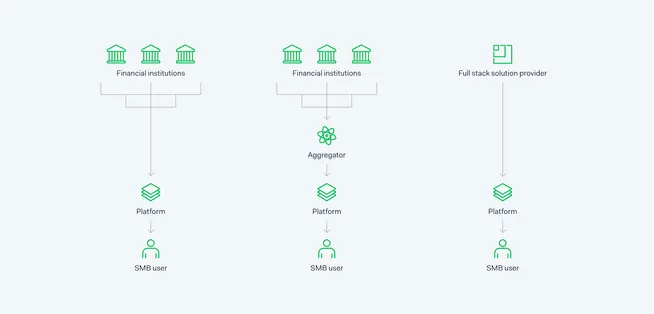
Dealing directly with financial institutions
By cutting out intermediaries, going straight to the source may seem logical for a platform. But remember back when the payments landscape was fragmented, overly complex, and suffered from slow processes?
There's the likelihood of running into the same issues if working directly with traditional financial institutions to embed financial services. This is because their digital transformation is slower and often lacks the needed technology stack, which hinders innovative, tailored user experiences.
When you look at global operations, the complexities are only multiplied. Take setting up embedded finance in the US for example; if you want to expand, you must find another banking partner and comply with different local regulations. As a result, your entry into new markets will be slow because of the additional operational lift.
Working with aggregators
Embedded finance is becoming attainable for more platform businesses thanks to aggregators. Aggregators are BaaS providers partnering with banks to offer one or more banking functionalities. They own the financial technology layer needed for platforms to integrate banking services.
Aggregators must work with traditional financial institutions in order to leverage their banking licenses and infrastructure, and that dependency adds latency to money movement.
For starters, an aggregator's service level depends on banks. In the scenario an error occurs, the banks are brought in to troubleshoot. In turn, this will slow down the entire process of solving issues for your users.
Furthermore, aggregators need to meet the requirements set by external policymakers (in this case, banks) since they aren't the decision-makers. These requirements differ from one bank to another, which could mean different risk thresholds and documentation needed from SMB users. With this inconsistency your platform's service level is limited, as are the users you can work with.
Last but not least, many aggregators don't offer all the banking functionalities that platforms need, leaving platforms in a fragmented situation as they work and integrate with multiple aggregators.
Choosing a full-stack BaaS provider
What is there was a better way to set up your platform with embedded finance? Adyen's single financial technology platform as the full-stack BaaS provider gives you more than the end-to-end infrastructure. You gain the reliability and flexibility to save you and your users valuable time and money.
Regulatory reliability
From risk management to balance sheet optimisation, you must trust that your embedded finance partner is fully compliant and up to speed with local regulations. Compliance is built in because our own banking licenses are part of our full-stack solution. As a tech-led bank, you can rely on us to meet regulations while ensuring speedy innovation. When working with us, you can set up, launch, and scale quickly, remaining fully compliant with the latest requirements.
Global scalability
Aggregators seeking a global service must work with multiple banks and card providers worldwide. For platforms, this may mean keeping up with different KYC requirements, and it can limit their product offerings across different regions, putting additional strains, whether in terms of operational costs, or opportunities to expand into new markets.
Our full-stack solution works on a global scale. You gain access to markets we already operate in and new ones as soon as we add them to our offering. And this is all within the same banking infrastructure. So you can have consistent product offerings, regardless of your users' location.
Fast innovation and agile growth
Innovation is faster when third parties don't weigh you down with turnkey solutions. We have full control of our in-house solution so you can speed up your product development and differentiate your offering from your competitors by catering to your users more efficiently. You can also tailor products and features according to your users' needs, all within the same platform to stay safe from fragmentation.
How Adyen can help
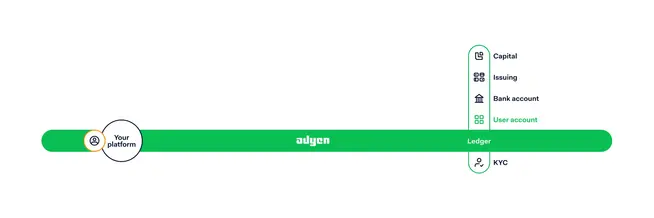
Platforms need to forge the right partnerships to provide reliable, compliant, and flexible financial experiences to their users.
You can choose from our repertoire of solutions depending on your business model and user needs.
Offer branded business bank accounts to your platform users so they can get instant access to funds.
Generate a flywheel effect by offering your platform users access to fast and flexible cash advances so they can fuel their growth and, in turn, yours.
Offer physical and virtual payment cards with your branding and let users immediately spend incoming funds from their cards.
Ready to take the next step for your platform? Get in touch.
How to bring banking services to your software platform
Here are the three ways to bring banking services to your platform, each with different implications for speed, control, and global expansion:
Traditional financial institutions
Some companies choose to partner directly with an established bank. Traditional banks often rely on older technology stacks that aren't designed for modern API integrations. This can lead to longer development cycles and difficulty in customizing the user experience.
If a business plans to operate in multiple countries, it may need to enter into separate deals with different banks in each region.
Aggregators
Aggregators act as a middle layer between your platform and a partner bank. They provide the modern software tools and APIs that traditional banks lack.
Aggregators make the initial integration easier, but add another layer of communication. If a transaction fails or a technical issue arises, the aggregator has to coordinate with the underlying bank to resolve the issue, causing delays.
Businesses using aggregators are still subject to the third-party bank's risk appetites and policies, which may change and affect the ability to serve certain types of users.
Full-stack BaaS provider
A full-stack Banking as a Service provider combines the banking license and the technology platform into a single solution. This model eliminates reliance on external banks because the provider owns the infrastructure and has the required regulatory permissions.
A full-stack BaaS provider offers the highest level of reliability and speed. Since the technology and the license live under one roof, updates can be made faster, and money movement is more efficient.
For platforms looking to scale, a full-stack provider with global licenses ensures a consistent product experience as the business expands into new markets.
How Adyen supports platform growth
Choosing the right partner is essential for maintaining compliance and delivering a high quality user experience. Adyen provides a single financial technology platform that integrates all aspects of BaaS into one system, including:
Capital: You can offer flexible business financing based on the transaction history seen on your platform, helping your users grow without the hurdles of legacy lending.
Accounts: You can provide branded business accounts to your users, allowing them to manage their funds and view their balance within your platform interface.
Issuing: You can create and manage physical or virtual payment cards. This enables your users to spend their earned funds immediately, whether they are paying for business supplies or managing employee expenses.
By using a unified platform, you avoid the complications of managing multiple vendors and fragmented systems. This allows you to launch financial products quickly and focus on providing value to your users, while the complexities of banking are managed on your behalf.
Get in touch to learn more about how to integrate financial services into your platform.
Key summary
Banking as a Service allows platforms to embed financial products like accounts and cards into their existing software offering
BaaS providers handle the complex regulatory and compliance tasks so that businesses can focus on user experience
Embedded finance increases user retention by making the platform a central hub for both operations and money management.
Interchange revenue provides a scalable way for platforms to earn a share of the fees generated during card transactions
Full-stack providers offer the most reliability and global reach by combining banking licenses with modern technology in one system.
FAQ
No. Open banking involves sharing financial data from a traditional bank account with third-party providers via APIs to give users better insights or services. Banking as a Service allows a business to actually provide the banking product itself, such as a card or account, rather than just viewing the data from an existing one.