
Article
Agentic commerce and product feeds: a guide for retailers
Why product feeds are now critical for AI-driven discovery and what retailers need to fix to show up where customers are searching.

If you're a payments manager at a retailer, agentic commerce has probably already landed on your desk, through conversations with your PSP, questions from leadership, or both. The questions tend to be the same:
When is this actually happening?
Are we ready for it?
What does it mean for how customers find our products?
AI platforms are still in the early stages of onboarding merchants, and fully automated checkout isn't here at scale yet. However, a big shift is already underway behind the scenes.
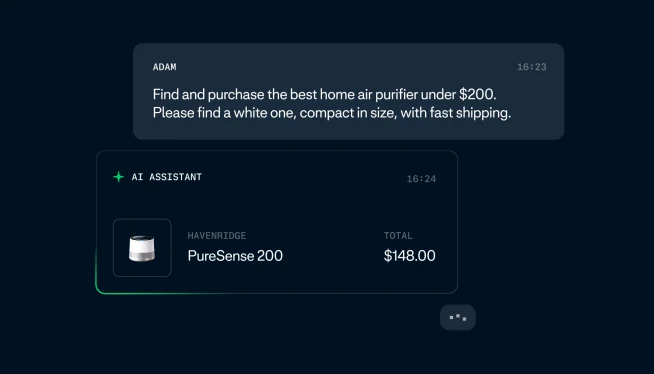
More shoppers are starting their product searches in AI tools rather than traditional search engines. This isn't just a new channel; these machine-led systems behave in fundamentally different ways from people. Most retail infrastructure wasn't built for that, which is why one question keeps coming up:
How do we get our products to show up in LLMs?
This article looks at what that actually involves, why it's landed with payments teams, and what you can do to prepare. We’ll cover:
Why product feeds have landed on your desk
Why having a product feed isn't the same as being ready
Three steps to getting your product feed ready
What to do if you’ve built an MCP server
How Adyen can support you
Thinking through what agent-ready product data looks like for your business? Get in touch, or read our guide to agentic commerce for retailers.
Why product feeds have landed on your desk
Product data doesn't belong to one team. It sits across ecommerce, merchandising, logistics, compliance, and operations. So, why are agentic commerce questions converging on payments?
Agentic commerce conversations tend to start with PSPs, card networks, and payments infrastructure. So the early guidance on what's actually possible, what's realistic, and what can wait typically reaches the business through payments first.
Plus, because product data touches so many departments, the payments team's cross-functional visibility becomes genuinely useful. You may not own the data, but you can see across ecommerce, finance, fraud, legal, and operations in a way most teams can't. That makes you well-placed to coordinate the right people around the right questions.
Having a product feed isn't the same as being ready
Most retailers already have a product feed. It might live in a PIM system, come from your commerce platform, sit in a Google Merchant feed, or be a mix of all three. And you're probably already optimizing your catalogue for people and search engines, with clear titles, good descriptions, and well-organized categories.
But that doesn't make your feed ready for AI.
AI platforms follow strict product feed requirements such as specific fields, consistent formatting, and up-to-date data, which are often beyond what a standard ecommerce feed includes. Traditional ecommerce optimization is about making listings appealing to people. AI systems have different priorities, such as whether your data is structured, complete, and machine-readable.
Unlike a traditional website journey, this doesn't just happen once at checkout. AI systems may check pricing, availability, and eligibility multiple times during a single interaction. So, inconsistent or outdated data becomes visible quickly.
There's also a structural layer to this. Each AI platform has its own requirements, so retailers currently need to adapt their product data for each one separately. That means repeating similar mapping, formatting, and updating work across platforms, with ongoing maintenance each time requirements change.
Most enterprise retailers are somewhere in the middle of this journey. Some data is structured, some is spread across systems, and some isn't available in real time. To understand where you stand, ask yourself:
Can our feed connect to real-time inventory?
Does it reflect live availability?
Does it show accurate pricing and eligibility?
Can we adapt it to match different AI platform requirements?
Three steps to feed readiness
The gaps in your product feed setup will likely span teams and systems. So, the work is as much about coordination as it’s about technology. Here's a practical way to approach it:
1. Validate your existing feed against AI specifications
The first step is to check your feed against the platform's actual requirements, not assume it works because your catalogue works today. AI platforms are specific about what data they need, and fresh, accurate data is a key signal they use to decide what to show. If your feed is missing fields, out of date, or inconsistent, your products may show errors that undermine trust in your data. Or, they may not appear at all.
2. Work with other teams to plug data gaps
The product information you need is probably already somewhere in the business, just owned by different teams. So the first challenge is coordination. You'll need to:
Find what's missing: Look at the required fields and identify what isn't in your current feed. Common gaps include weight, dimensions, delivery timelines, returns policies, and regulatory details.
Work out where it lives: These fields are often owned by logistics, operations, finance, or compliance, not ecommerce.
Bring the right people together: You don't need to rebuild your systems. The goal is to ensure the data can be accessed and used as AI platforms require.
In most cases, this means reconciling data across your PIM, commerce platform, order management system (OMS), inventory tools, marketplace feeds, and Google Merchant Center. The key questions are:
Which system is the source of truth for pricing, availability, and eligibility?
Who is responsible for keeping that data accurate and up to date?
3. Decide who owns AI-ready product data
Regardless of how many systems your product data spans, AI platforms expect it to be delivered in a single, consistent, up to date format. Retailers are approaching this in a few different ways, each with trade-offs:
Extend your PIM: Adding fields and AI logic to your PIM keeps ownership close to your catalogue and merchandising teams, but may require significant development work.
Use your commerce platform: Exposing product data through APIs and connecting directly to AI platforms can be quicker to set up, but may introduce dependency on your platform's roadmap.
Build your own translation layer: Creating a service that pulls data from different systems, standardises it, and formats it for each AI platform gives you full control, but requires ongoing maintenance as requirements change.
Work with a payments or infrastructure partner: Letting a partner handle how your data is prepared and shared with AI platforms can reduce custom development work, but means relying on an external layer.
There's no single right answer. The best approach depends on your engineering capacity, how much control you want to retain, how many platforms you plan to support, and how frequently your data changes. Fast-moving sectors like travel, marketplaces, and food will need tighter real time integration than more static catalogues.
In practice, this is less about picking a tool and more about deciding how your systems work together to keep product data accurate, current, and ready for AI.
If you've built an MCP server, what can you do with it?
Some AI platforms now let businesses create branded experiences within their interfaces. If you've built an MCP server, you can use it to power one of these by connecting your server to the platform, building a conversational experience aligned with that platform's conventions, and letting users select your brand before interacting.
Retailers taking this approach tend to fall into two camps.
Some are using it to experiment with AI-native brand experiences. This tends to work best where customers already search directly for the brand, the journey benefits from step-by-step guidance, or the product is complex to configure.
Others are focused on ensuring their products appear in general AI searches alongside other brands when users ask broad questions. For most payment managers, this is the more immediate priority.
Which approach makes sense depends on your brand and your customers, and they're not mutually exclusive. Whether you're building a branded experience or optimising for general discovery, the underlying preparation is the same. You’ll need structured, machine-readable product data, accurate pricing and availability signals, clear policies, and a way to adapt as platform requirements evolve.
How Adyen is supporting retail payment teams
Based on our conversations with enterprise retailers and AI platforms, the most pressing challenge for agentic commerce is infrastructure. So, that's where we're focused.
We're working with retailers and AI platforms to share what's being asked for today, help payments teams decide what’s worth doing now, and support preparation without pushing decisions that may be difficult to unwind later. We're also contributing to discussions on emerging standards, so you don't have to commit too early to any single approach.
At the infrastructure level, we're focused on where AI interfaces meet real commerce systems. Our goal is to reduce fragmentation, support multiple standards, and help you avoid separate integrations for every new platform.
Our focus throughout is on helping retailers maintain control over their data and customer relationships.
Key takeaways for retail payments managers
Nobody expects you to have agentic commerce figured out. But the conversations you're already having with PSPs and partners give you a clearer picture of what's realistic than most teams have. That puts you in a good position to help your organisation focus on the right things. Here’s what to keep in mind:
Having a product feed doesn't mean you're ready. AI-led discovery requires explicit specifications, required fields, and data freshness beyond traditional ecommerce feeds.
The biggest blockers are fragmented data, unclear ownership, and assumptions about what already exists. These are solvable, but they require cross-functional coordination.
You don't need to bet on a single AI platform to prepare. Clean, structured, machine-readable product data is reusable across AI assistants and discovery surfaces.
Focus on readiness without lock-in. Build foundations you can adapt as standards and AI platforms evolve, rather than committing too early to specific implementations.
Good product data is the starting point. But making it work across AI platforms also means keeping it up to date, translating it into different formats, and adapting it as requirements change. As someone who works across teams, you're well-placed to drive that.
Thinking through what agent-ready product data looks like for your business? Get in touch, or read our guide to agentic commerce for retailers.