Align with the local: 5 lessons from Châteraisé’s Southeast Asia expansion
Discover how Châteraisé’s decision to sync different payments systems across multiple markets saved time and improved customer data.
For many companies, international growth is the dream. But as Châteraisé learned along the way, the road there gets messy with multiple markets and different payment systems. Now, the Japanese confectionery brand has 163 stores across seven countries.
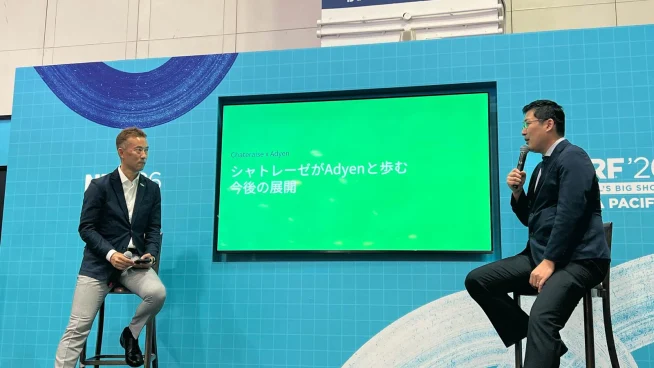
Payment fragmentation is a common challenge for any company expanding into new markets, so we were excited to hear from Châteraisé about their key learnings. Masayuki Matsuoka, Director Châteraisé Singapore joined Takumi Sano, our Head of Sales at Adyen Japan, on stage at NRF Retail's Big Show APAC to share their takeaways since expanding in Southeast Asia and how it’s about truly understanding what the locals need.
1. Protect your brand experience
Expanding into new markets requires building trust in the brand. Châteraisé understood that Singapore’s customers wanted the freshness and quality their goods were known for in Japan, and they were determined to deliver. “Customers often ask us if our products are made locally in Singapore,” Matsuoka explained. “The vast majority are manufactured in our factories in Japan. Once produced, the items are flash-frozen and shipped to each country. They are then stored in local frozen warehouses, delivered to stores via refrigerated trucks, thawed on-site, and finally displayed on the shelves.” This way, Châteraisé doesn’t compromise on its standards, ensuring every customer, whether in Singapore or Japan, enjoys the same product experience.
2. Balance scale with standardization
As Châteraisé grew their franchise-driven business in Singapore, they found themselves with a big problem: Their eight franchise owners each had their own payment methods. This meant that they could not centrally manage transaction data. Fees and security standards were inconsistent across the board. A certain payment method might be accepted at one store, but not another, causing much inconvenience for customers. “As we gradually expanded the business, we simply couldn't find the right time to switch over, which is how we ended up in that situation,” Matsuoka noted, highlighting the importance of resolving these frictions as early as possible. Châteraisé eventually partnered with Adyen to unify operations across all points of sale, creating a centralized system for better operational visibility.
3. Streamline your workflow for better operational visibility
Once payments were unified, sales data became consolidated too, providing a fuller picture of customer behavior. Previously, they could only review this after closing their books, but with Adyen as “the only partner that allows us to track sales data in real time”, Châteraisé was now able to get an immediate snapshot of any given store. This includes insights into which demographics are buying which products, at which stores, and for how much, right down to the exact hour. With this information, they can now react more promptly and effectively.
“Singapore posed many hiring challenges, and with issues retaining store staff, we struggled to fully commit to our service quality. However, if the system shows them that "this customer visits us with this level of frequency," even a brand new staff member can provide proper, informed service.”
Masayuki Matsuoka
Director, Châteraisé (Singapore) Pte. Ltd.
4. Payment is a form of customer service
Payments are more than just transactions and Châteraisé understands that a well-planned payments strategy has the potential to secure customer loyalty. Matsuoka summed it up perfectly: “Payments represent the final touchpoint with our customers. The feeling we want them to have at that exact moment is "I want to come back". It can be as simple as offering customers the ability to pay whenever, however they like. In Singapore, Châteraisé frequently received phone orders, but this came with many manual steps to ordering, contributing to a poor customer experience. It was only until they made the switch to Adyen that payments could be processed much faster via Pay By Link. Additionally, the benefits compound as real-time sales data allows Châteraisé staff to quickly tell regular customers apart from first-time visitors, and tailor their approach accordingly.
5. Innovation isn’t just for products
After establishing itself in Singapore, Châteraisé decided to push the boundaries of traditional payments and opened its first unstaffed store. The store has no cash registers and customers can simply take their desired items and walk out. Payment is made automatically and smoothly through a mobile app supported by Adyen. With Adyen’s in-built features, Châteraisé could also store performance and purchasing trends in real time.
“We can use the analysis to provide immediate feedback… Our supervisors can perform "horizontal comparisons" when they visit stores, allowing them to discuss why a store achieved a certain level of sales. This enables store managers to see areas of improvement and pursue better results.”
Masayuki Matsuoka
Director, Châteraisé (Singapore) Pte. Ltd.
Go local, grow global
Scaling globally is an ambition of high stakes and many moving parts. As Châteraisé’s story shows, success comes down to working with the right partner. Adyen accepts payments in almost 100 countries, and lets you unlock over 250 payment methods globally all on one platform that integrates smoothly with your current infrastructure.
Get in touch with us and let’s talk about how we can make payment the simplest part of your customer journey, in any country.