2026 SME PAYMENTS REPORT
The 2026 state of SME payments in the UK
What's in this report
Embedded payments represent a significant opportunity for SaaS platforms serving SMEs in the UK.
By embedding payments directly within the software SME customers already use, platforms can help play a more central role in how these businesses operate: simplifying operations, reducing reliance on separate providers, and laying the groundwork for broader financial services.
Adoption is already established. 60% of UK SMEs report using their platform’s embedded payments solution, and nearly one in three non-users are “considering adoption” within the next 12 months.
That said, adoption isn’t automatic. SMEs still weigh the benefits of switching against existing payment processes, perceived complexity, and the need for flexibility.
To understand the current landscape, Adyen partnered with Visa to survey 1,506 SMEs globally, including 506 in the UK, between January and March 2026. This benchmark examines five areas shaping SME adoption of embedded payments in the UK:
Adoption drivers
Adoption barriers
Perceived value
Industry patterns
Opportunities beyond payments
Methodology: Based on an Adyen and Visa survey of 506 UK SMEs, conducted January to March 2026. Respondents were decision-makers for payment systems at businesses with up to 250 employees, all using software platforms. Global comparisons draw from the full dataset of 1,506 SMEs across the UK, US, and Germany.
How the UK compares to other markets
How the UK compares to other markets
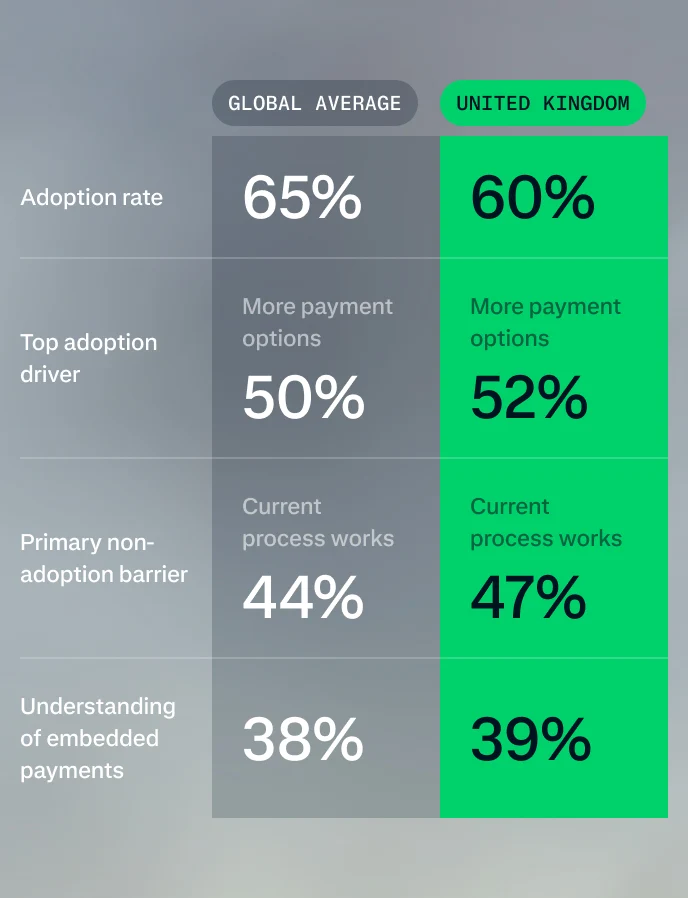
UK adoption sits at 60%, five points below the global average of 65%. The reasons SMEs adopt are broadly consistent with global markets. In both, the leading driver is the ability to offer more payment options, with this motivation slightly stronger in the UK (52% versus 50% globally).
The bigger difference lies in what’s holding SMEs back. Nearly half (47%) of UK non-considerers say their “current process works,” compared with 44% globally. This suggests greater comfort with the status quo, making it important that the case for switching is built around clear, tangible benefits that outweigh the perceived value of sticking with the current process.
Adoption drivers
Offering more payment methods is the leading adoption driver
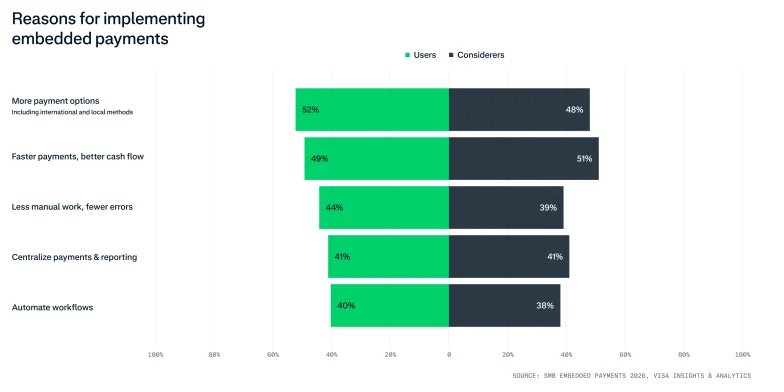
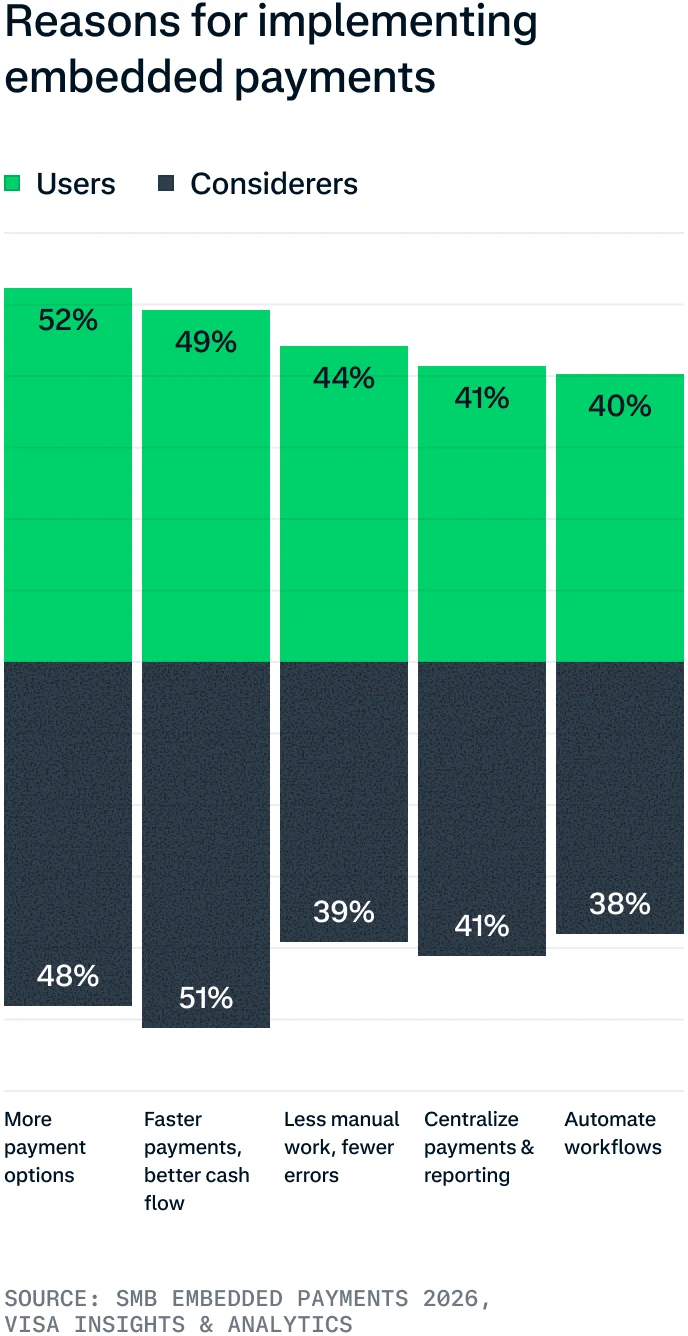
For 52% of UK SMEs, offering customers more payment methods is a key reason to adopt embedded payments, making it the market’s strongest driver.
The finding underscores how meeting customer expectations across cards, digital wallets, and local payment methods has become table stakes in the UK. Faster access to funds follows closely (49%), alongside reducing manual work (44%), and bringing payments, orders, and reporting into a single system (41%).
Taken together, these priorities suggest that SMEs increasingly value embedded payments for the operational benefits they deliver, not simply their ability to process transactions.
For SaaS platforms, this makes the positioning clear: lead with business objectives, such as broader payment coverage, faster cash flow, and streamlined operations, rather than the underlying technology.
Adoption barriers
Comfort and caution are the biggest adoption barriers
For UK SMEs that have not yet adopted their platform's embedded payments solution, the primary barrier is comfort with established payment relationships and workflows.
Case in point: PayPal (49%), Barclaycard (32%), and Google Pay (31%) are among the most widely used providers. As a result, many non-users say they won't switch because their current payment process works (47%) or that their customers prefer invoices or manual payments (29%).
Among UK SMEs actively considering adoption, the picture shifts from comfort to execution risk. Research shows that the leading obstacles are:
Technical issues experienced during a previous implementation (23%)
A preference to keep payments separate for control or simplicity (21%)
Inadequate onboarding or customer support (20%)
These objections highlight where platforms can make their value more tangible:
Execution concerns are best addressed with proven, low-disruption integrations, and clear implementation support.
Control concerns can be addressed with modular options that allow payments to sit alongside existing systems and processes.
Onboarding concerns call for guided setup and hands-on support, so SMEs aren’t left to navigate the process alone.
The takeaway: the case for switching needs to address the specific barrier. For SMEs comfortable with the status quo or wary after a poor experience, generic adoption messages won’t cut through. Platforms need to show how their solution fits existing workflows and removes friction.
Perceived value
UK SMEs recognise value beyond payment acceptance
SMEs already using their platform’s embedded payments solution report benefits that extend beyond processing transactions:
Better customer experience (88%)
Faster payouts and cash flow (87%)
Reduced administrative effort (85%)
These benefits show that embedded payments can help improve more than the payment experience itself. When payments connect with invoicing, reconciliation, and reporting, SMEs can reduce manual work, improve financial visibility, and simplify day-to-day operations.
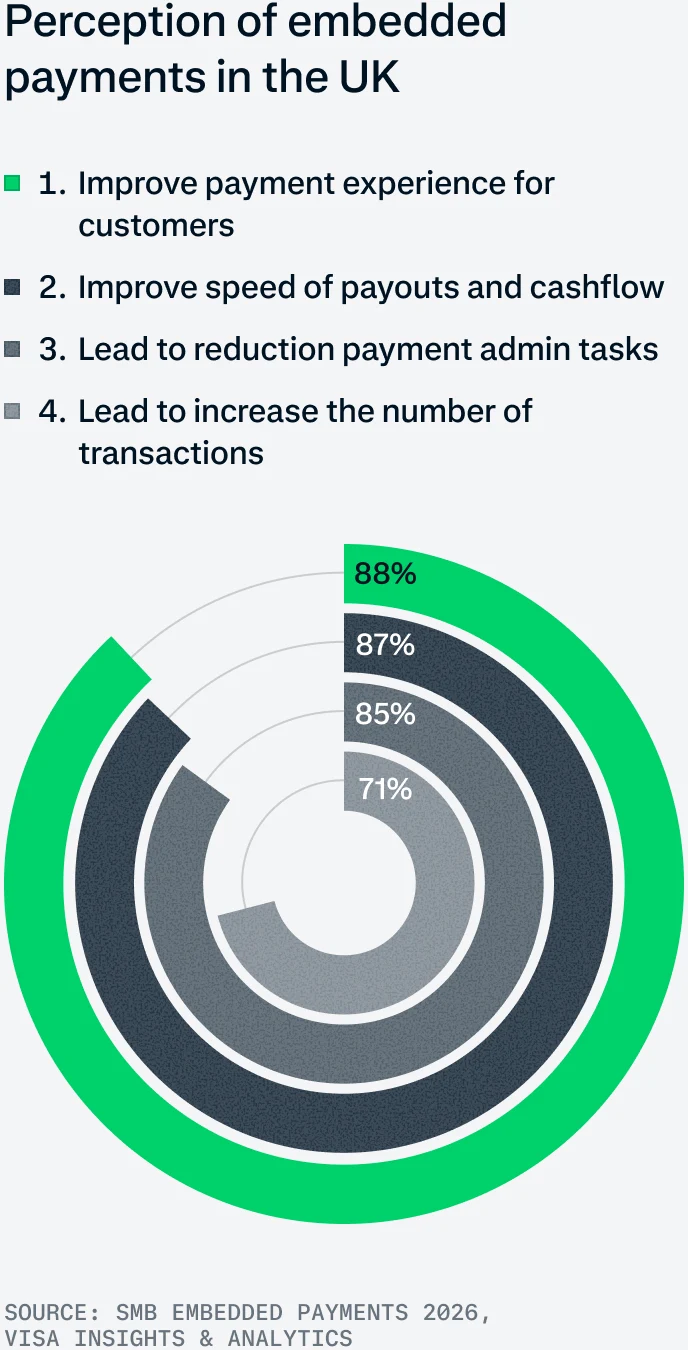
However, the value of embedded payments may not be fully realised.
UK SMEs recognise the operational gains, but are less likely to connect embedded payments with commercial impact. Just 71% associate them with an “increased number of transactions,” making this the lowest-rated benefit. Without that link, payments risk being viewed as a cost to manage rather than a source of growth.
For SaaS platforms, the opportunity is to make that commercial value more tangible, and help SMEs quantify the impact of embedded payments on their business.
Industry context shapes how platforms unlock embedded payments value
Healthcare: Helping solve operational complexity
Of the SMEs surveyed in the healthcare industry, 74% report adopting their platform's embedded payments solution. While it represents a high adoption rate, only 42% say they fully understand embedded payments as a concept.
This suggests that adoption is often driven by solving an immediate operational challenge — billing, reconciliation, and reporting — rather than a clear awareness of embedded payments as a category. However, it does point to a growing shift away from legacy payment setups and towards software providers that fit naturally into their workflows.
Healthcare platforms can deepen awareness by helping SMEs see value beyond operational fixes, like faster payouts and payment method flexibility.
Retail: Building a more integrated operating experience
Retail SMEs show solid adoption (60%), supported by demand for a wide range of payment methods. 86% view embedded payments positively, citing improved customer experiences and faster payouts, among the top benefits.
However, day-to-day priorities like stock management, sales tracking, and fraud prevention remain pressing for retail SMEs. Beyond embedded payments, 42% desire basic accounting tools and 34% want fraud and security features. It points to a clear appetite for a more integrated retail operating experience.
For retail platforms, the opportunity goes beyond payment acceptance. LPM coverage and faster payouts are a good place to start, but connecting payments to the broader commerce workflow — reporting, fraud protection, and operational visibility — will help SMEs run their business.
Professional services: Educating before adopting
Professional service SMEs show lower adoption (55%) and understanding (38%), reflecting an industry where manual invoicing, complex billing structures, and open banking payments are the norm.
That said, perception of embedded payments is positive. Over 80% of respondents cite faster payouts and improved customer experiences as top advantages. And many want invoicing tools (47%) and basic accounting features (39%) from their software platforms.
This vertical is an education-first opportunity. For platforms serving professional services, it’s important to highlight how embedded payments can automate collections, streamline reconciliation, and give SMEs real-time visibility into their financial health.
Across industries, research shows that the themes are consistent.
Platforms that help SMEs unlock greater value from their payment setup become further embedded in how those businesses work. The focus shifts from increasing adoption to connecting transactions with the workflows, insights, and experiences SMEs need to be successful.
Building the foundation for broader financial relationships
Embedded payments can become the foundation for deeper financial relationships between SaaS platforms and their SME customers.
Today, traditional providers remain the primary source of SME financing, with 42% of UK SMEs borrowing from a traditional bank and 34% from a business credit card, compared to 15% borrowing through their software platform.
However, SME expectations are shifting towards financial products that are simpler, faster, and more connected to how they actually operate. It creates an opportunity for platforms to compete on relevance.
When evaluating lending solutions, SMEs place greatest importance on factors like total cost, lender trustworthiness, and a simple application process.
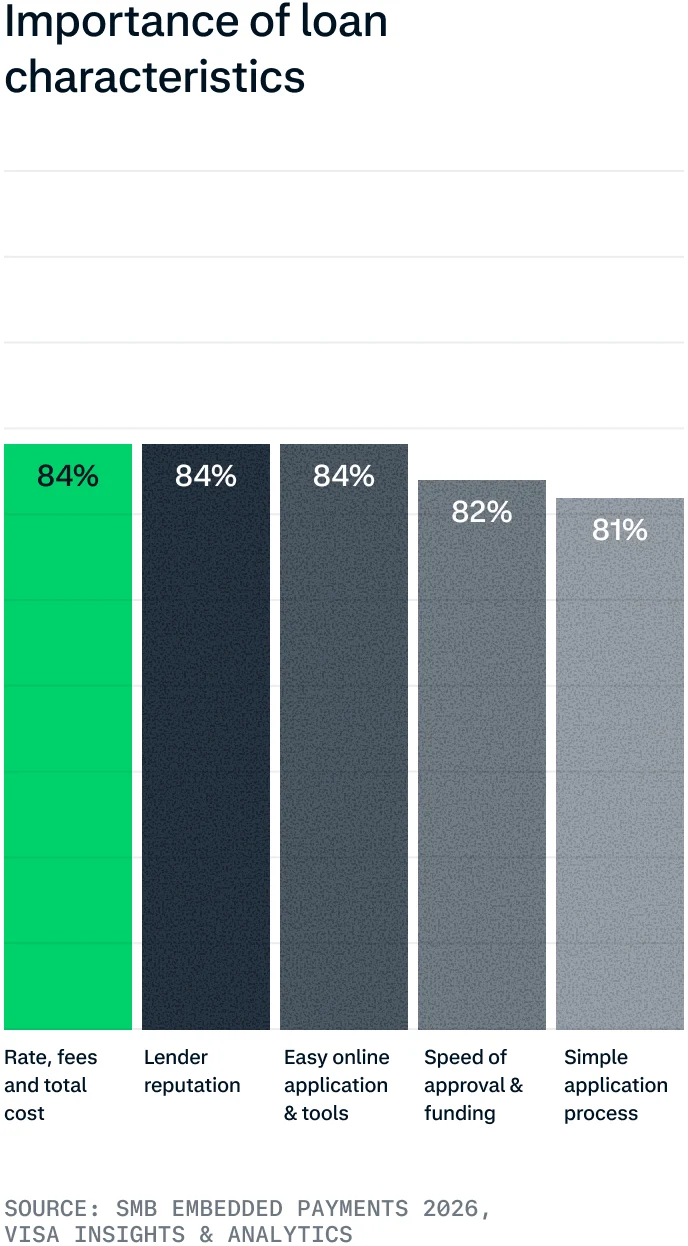
These priorities align with SaaS platforms that already manage critical workflows and have access to transaction data.
A platform that processes an SME's payments has a clearer picture of their revenue patterns and business health than any traditional lender, giving it a meaningful advantage.
But trust is still the deciding factor. Financial products require a deeper relationship than payments alone, which means platforms need to deliver consistent value through everyday experiences before expanding into lending.
The takeaway:
Payments come first. The broader financial relationship follows.
Embedded payments adoption is established, but deeper trust must be earned
The UK market is moving beyond early adoption. Three in five SMEs already use embedded payments and awareness aligns with the global average.
The challenge is no longer proving that embedded payments work. Most SMEs already rate the experience positively.
Instead, it’s about earning the trust to play a more central role in how their business runs. Many remain comfortable with their current approach, making the perceived risk and disruption of switching a significant barrier.
For SaaS platforms, that trust is built through consistent execution: seamless everyday experiences, solutions to real business problems, and a credible, low-risk path into broader financial services.
The goal is to become a trusted operating partner that SMEs can rely on.
Five principles for building in this market
Lead with payment breadth and cash flow
Offering more payment methods and faster access to funds are the strongest adoption drivers in the UK. Start the value conversation there.
De-risk the switch
Comfort with existing processes and concerns about implementation can hold adoption back. Demonstrating low-disruption integration, backed by hands-on onboarding, can help make the move feel more manageable.
Let payments run alongside, not instead of
Many UK SMEs use multiple providers and some prefer to keep payments separate. Modular integration can offer a lower-friction path, without requiring a wholesale change to existing systems.
Educate where understanding lags
Awareness of embedded payments is still developing, particularly in professional services. Clear education can help make the proposition more tangible and connect it to the business outcomes that matter most.
Payments are the foundation
Embedded payments can deepen the platform relationship by creating more frequent engagement and generating transaction data that supports expansion into broader financial services.
About
Methodology
Based on an Adyen and Visa survey of 506 UK SMEs, conducted January to March 2026. Respondents were decision-makers for payment systems at businesses with up to 250 employees, all using software platforms. Global comparisons draw from the full dataset of 1,506 SMEs across the UK, US, and Germany.
About Adyen
Adyen (AMS: ADYEN) is the financial technology platform of choice for leading companies. By providing end-to-end payments capabilities, data-driven insights, and financial products in a single global solution, Adyen helps businesses achieve their ambitions faster.
About Visa
Visa (NYSE: V) is a world leader in digital payments, facilitating transactions between consumers, merchants, financial institutions and government entities across more than 200 countries and territories. Learn more at Visa.com
Disclaimers:
Comparisons, statistics, research, and recommendations are provided “AS IS” and intended for informational purposes only and should not be relied upon for operational, marketing, legal, technical, tax, financial, or other advice. Visa neither makes any warranty or representation as to the completeness or accuracy of the information within this document, nor assumes any liability or responsibility that may result from reliance on such information. The Information contained herein is not intended as investment or legal advice, and readers are encouraged to seek the advice of a competent professional where such advice is required.
All brand names and logos are the property of their respective owners, are used for identification purposes only, and DO NOT imply product endorsement or affiliation with Visa or Adyen.
Get the report's key insights
A summarised PDF to read, share, or revisit later.