Article
Built for the busiest days of the year
Peak season is not a Q4 sprint for us; it’s when a year’s worth of consistent engineering excellence gets proven in public.

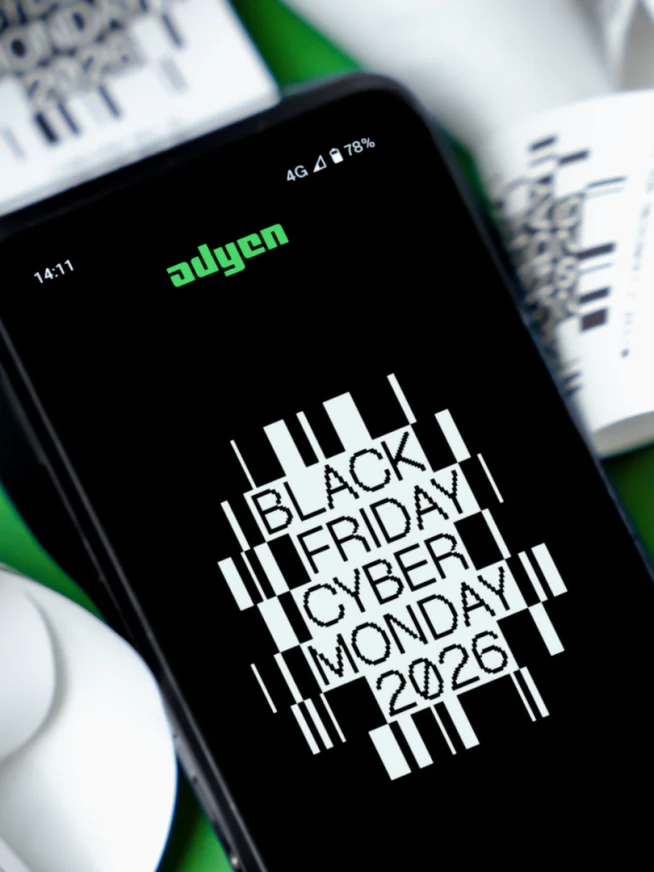
For many of the businesses we serve, the coming weeks decide the year. Shoppers show up in record numbers in stores and online, and your payment engine needs to be ready to perform.
Peak season is not a Q4 sprint for us; it’s when a year’s worth of consistent engineering excellence gets proven in public. As we head into this busy time of the year, I wanted to share a closer look at how we prepare, what you can expect from us, and what you can do to be ready.
Peak season has kicked off across the globe
Peak season 2026 began with Singles' Day on November 11 and runs through the holidays into the new year. And while Black Friday/Cyber Monday weekend is historically the high point of the season, volume is actually spread across several weeks.
Singles' Day has already set the tone for this year. We processed over $7B on November 11 (24 hours, CET), up 16.5% compared to last year and 28.9% compared to 2024. This week tabled another test of our preparations with Adyen’s gaming customers overseeing one of the biggest entertainment launches in a decade, with everything running as it should.
Capacity planning for the worst case scenario
$7B of volume in a day is a big number, but we actually had extra capacity during Singles’ Day.
We conduct capacity planning as a continuous exercise, not a Q4 activity. Our platform runs across multiple of our own data centers in the US, EMEA, and APAC, with no single third-party point of failure in our core operations.
Our standard is that our platform must be able to handle peak volume, even with an entire data center down. We test this by taking capacity away from ourselves before the season starts, so that by the time Black Friday arrives, we’re confident in our ability to handle peak volume, even when operating at less than full capacity, so that peak traffic is business as usual.
Last year's Black Friday and Cyber Monday weekend showed what that looks like in practice: uptime above 99.9999% across our public APIs.
Every team proves they’re ready
At Adyen, we have several hundred engineering teams across the globe. To make sure everyone is ready for peak moments, every team conducts an in-depth Operational Readiness Review: a continuous peer-reviewed defence of their service's architecture, resilience and operations.
Teams demonstrate readiness across three areas:
Observability: Do alerts signal real symptoms like latency while minimising noise, so people can think clearly during an incident?
Scalability: Can teams demonstrate their service won't hit contention bottlenecks under extreme load?
Redundancy and failover: Are failovers not only automated but also clean, with no data inconsistency (even during an unexpected failure)?
This peer review process confirms readiness, as well as identifies edge cases and process fixes we may not have otherwise have found.
We’re always on call
Our teams monitor the platform around the clock, tracking authorisation rates, traffic, errors, and payouts. During peak moments, we add extra people to our 24/7 on-call teams, and specialists stay on standby to manage live incidents.
If something does happen, we alert affected merchants directly. The will also always display live updates. Subscribing to System Messages is the best way to get the most current information.
What peak season looks like from the inside
Peak season readiness isn't only our responsibility. The retailers we work with treat it as a company-wide project. Pandora, the world's largest jewelry brand, is a great example of what that looks like in practice:
They start in July. Black Friday planning begins in the summer. From September, ecommerce, payments, infrastructure, and retail teams meet weekly, and work runs in two-week sprints so they can get ahead of potential missed deadlines early.
They stop shipping in November. From then on, no new payment methods or checkout features go live. The focus shifts to protection: page speed, checkout stability, and security.
They gather together. During Black Friday week, ecommerce, marketing, ops, and development work from one room in Copenhagen, clustered around an hourly payments dashboard. If an hourly target slips, the team rethinks on the spot.
They expect peak season to look different every year. Some years, shoppers hold out for Black Friday; other years, they spend the moment promotions start. So after every peak season, Pandora’s team dissects which days drove sales and what caused any smaller spikes.
This year, we'll also have a live view of the weekend and the world's biggest retail hubs on bfcm.adyen.com.
How merchants can prepare for peak season
The best peak season preparation will help you avoid surprises. We ask every merchant to:
Run through your go-live checklist for online payments one more time.
Check your Refund Reserve balance and configuration.
Update emergency contacts in the Customer Area under Account Settings, and consider a dedicated emergency email address if you are a large account.
Brief your support team on finding transactions in the Customer Area, issuing refunds, and defending chargebacks.
Where to find us
Platform status: status.adyen.com
Support, 24/7: support@adyen.com, the Support Contact Form in your Customer Area, or the phone numbers listed there
Documentation: docs.adyen.com
Help center: help.adyen.com
Peak season is also a time for giving back, and many of you are adding charitable donations to your holiday checkout. Whatever your plans, we are ready, and we wish every one of you a record-breaking few weeks.
Tom