Article
Interchange fees explained
Confused by how interchange fees are calculated? Learn how interchange rates work for different credit and debit cards and how they vary from country to country.

After every credit or debit card transaction, businesses need to pay an interchange fee, also known as an interchange reimbursement fee or interchange rate. Many variables can affect the fee amount, and it can be difficult to determine how much the charges will be.
In this article, we’ll walk you through how interchange fees work, the factors that impact interchange fees, where you can find the most up-to-date interchange rates, and the regulations that exist to ensure you’re paying a fair price.
What are interchange fees?
Every time a transaction is made via a card scheme (Visa, Mastercard, etc.), the acquirer pays the cardholder’s bank an interchange fee. The business then pays the interchange fee back as part of its card processing fees.
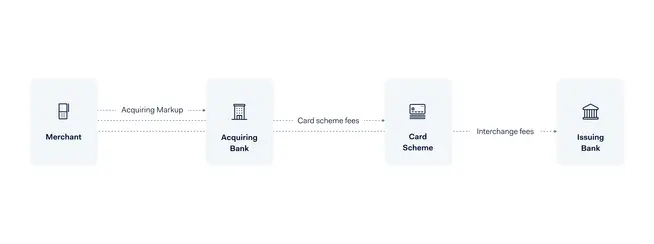
Payment card processing comes with three fees:
Acquirer markup: Charged by the acquirer for acquiring the funds from your shopper
Card scheme fees: Charged by the card scheme for using its network
Interchange fees: Charged by the cardholder’s bank
Interchange fees make up the most significant chunk of card processing fees.
How much are interchange fees?
In Australia, the interchange fees for credit cards cannot exceed 0.80% and 10 cents (or 0.20% if specified in percentage terms) for debit cards (as at March 2026). Similarly, the average interchange fees are around 0.3% to 0.4% of the transaction amount in Europe and 2% in the US.
Card schemes determine interchange fees and are non-negotiable. They are also regularly adjusted. For example, Visa and Mastercard publish new rates in April and October every year.
The most accurate and up to date way to find the current rates is to check the card scheme’s website. Below you can find the interchange rates for Visa and Mastercard in different regions:
Visa interchange rates: EU, US, SG, AU, IN Mastercard interchange rates: EU, AU
Some card networks, including American Express and Discover, work slightly differently to Visa and Mastercard and they don’t publish their rates online.
How are interchange fees calculated?
Many factors influence the interchange fee amount. Here are the key ones to be aware of and how they affect the amount you're charged:
Card scheme
Different card schemes charge different interchange rates. So the cost of a customer paying with a Visa card won't be the same as with a Mastercard.
Card-present vs. card-not-present
Card-present (CP) transactions, also known as face-to-face transactions, have lower interchange fees than card-not-present (CNP) transactions. This is because the risk of fraud is lower when the customer’s card is physically present.
Merchant category code (MCC)
Your assigned MCC can affect your interchange fees. For example, in Australia, Visa and Mastercard grant lower rates to businesses like charities, travel agents, streaming services, and utilities.
Consumer vs. commercial
Commercial cards charge higher interchange fees than those issued to an individual.
Transaction regionality
Domestic transactions, where the card-issuing bank is in the same country as the business, are generally cheaper than cross-border transactions.
Rewards cards
If a customer uses a rewards card to pay, the interchange fees are generally higher. This is because the increased fees pay for the extras offered by rewards programs.
Can you control any of these factors?
Some of the factors above you can influence, but others you can't change. For instance, if you convinced your customers to buy more in stores than online, you could reduce your interchange fees.
When it comes to your MCC, however, you have no control. Your MCC is assigned to you and is dependent on the type of business you have.
Lowering your interchange fees may not result in more profit. By limiting your customers' choices, you could deter them from purchasing from your business.
Interchange++ vs. Blended pricing
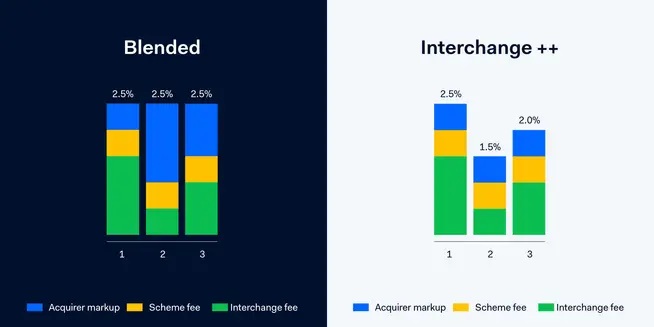
Interchange++ (or Interchange Plus Plus) and blended are the most widely used pricing models for card transactions. The main difference between the two is transparency.
Interchange++ shows you a detailed breakdown of the three payment card costs mentioned earlier: the acquirer markup, card scheme fees, and interchange fees.
You only pay the interchange fees the card issuer charged you. As interchange fees vary depending on many factors, they can sometimes be lower than a fixed rate.
The alternative to Interchange++ is blended pricing. The blended model charges an average processing cost plus a fixed markup. You're charged the same markup for every transaction, and you can't see the split of the costs.
This makes it easy to understand, but it is not transparent. And there's no guarantee your payment processor will share any savings with you made from lower interchange fees.
Interchange fees regulation
Traditionally, there was very little transparency into how interchange fees were calculated. Large businesses with a high volume of transactions could negotiate lower fees, while smaller firms had to pay the full amount.
Markets dominated by the large international card schemes were most vulnerable. Businesses couldn't afford to refuse the payment methods most of their customers used.
Fortunately, recent progress has been made to standardise interchange fees, with stricter rules and fee caps introduced, and overall transparency increased.
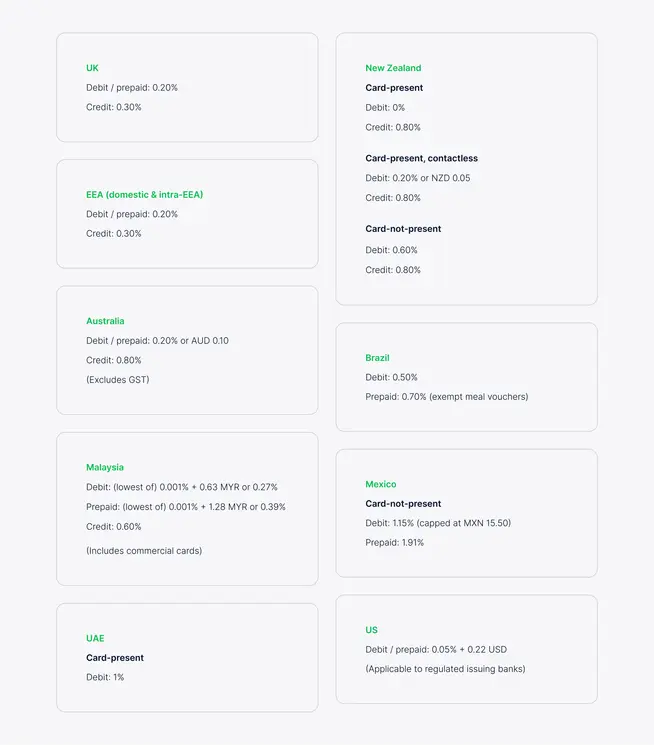
Below is a breakdown of the fees caps across different regions:
Australian Card Payments Regulation
Effective from July 2017, the Reserve Bank of Australia introduced an Interchange fees cap, which applies to domestic transactions for both consumer and commercial cards.
This cap applies to interchange fees for both credit and debit cards. Interchange fees for credit cards are not allowed to exceed 0.88%, while the debit fee cannot exceed 16.5 cents (if levied as a fixed amount) or 0.22% (if levied as a percentage amount). All caps include Goods and Services Tax (GST).
The Durbin Amendment (US only)
The Durbin amendment, enacted in 2010, is dependent on the size of the issuing bank's assets. If the issuing bank has assets of $10bn or more, its debit and prepaid cards will be charged regulated rates. These cards are then subject to an interchange rate of 0.05% + $0.21 or 0.05% + $0.22, depending on fraud prevention policies.
European Interchange Fee Regulation
The European Economic Area (EEA) introduced interchange fee regulation in 2015. This led to the heavy regulation of interchange fees and made the EEA one of the cheapest options worldwide.
Interchange fees are capped for consumer cards in all EEA regions, making it a good place to set up an entity for cross-border transactions. The precise caps are as follows:
Domestic
Debit
0.20%
Credit
0.30%
Intra-regional
Debit
0.20%
Credit
0.30%
Interregional card-present
Debit
0.20%
Credit
0.30%
Interregional card-not-present
Debit
1.15%
Credit
1.50%
How interchange fees are calculated
Interchange fees are usually a percentage of the transaction. The exact rate depends on multiple variables.
Key factors affecting interchange:
Here's a breakdown of the key factors to be aware of and how they affect the amount you pay:
Card scheme: Different card schemes charge different interchange rates. So the cost of a customer paying with a Visa card won't be the same as with a Mastercard.
Transaction type
Card-present (in person): Lower fees
Card-not-present (online): Higher fees (more risk of fraud)
Card type: Credit and deferred debit cards have higher interchange fees than immediate debit and prepaid cards, as the level of risk is considered higher.
Debit cards → lower fees
Credit cards → higher fees
Merchant category code (MCC): Certain industries may qualify for lower rates. For example, in the US and Australia, Visa and Mastercard offer lower rates to businesses such as charities, travel agents, streaming services, and utilities.
Consumer vs commercial cards: Commercial cards charge higher interchange fees than consumer cards.
Transaction location: Domestic transactions, where the card-issuing bank is in the same country as the business, are generally cheaper than cross-border transactions.
Domestic → cheaper
Cross-border → more expensive
Rewards cards: If a customer uses a rewards card to pay, the interchange fees are generally higher. This is because the increased fees pay for the extras offered by rewards programmes.
Can you reduce interchange fees?
Interchange fees are decided by the card schemes and can't be lowered through negotiations with your payment provider. However, there are some levers you can pull to help bring the fees down. A good payment provider will advise you on which of these will be most effective for you.
What you can influence:
Encourage debit payments: Debit interchange rates are consistently lower than credit, so nudging shoppers toward debit where you have the choice, for example through payment method ordering at checkout, can shift your average cost down over time.
Reduce fraud risk: Lower fraud rates can help you qualify for better interchange categories and reduce costly chargebacks.
Use local acquiring: Processing a transaction domestically rather than routing it cross-border tends to be cheaper. Across the top 100 businesses on Adyen's platform, domestic processing saved up to 59% compared with cross-border transactions. FlixBus saw this directly: after moving to local acquiring in the US, the business cut its bank declines by 21%, according to Dennis Friemerding, Team Lead Payments.
Route payments via the best network: In the US, most debit cards can be routed via more than one network. Adyen customers piloting Intelligent Payment Routing on US debit transactions saw a 26% average reduction in payment cost, alongside a 0.22 percentage point uplift in authorisation rate. One large US grocery delivery business saved $600,000 in a single month during the pilot.
Share more data with the schemes: Enhanced scheme data (ESD) is additional payment data about your customers’ purchases that you can send to the card scheme to qualify for lower interchange fees.
Optimise checkout flows: Small changes, like capturing accurate billing addresses or using 3D Secure where it lowers your risk category, can affect which interchange tier a transaction falls into.
If you want to understand how these changes show up in your reporting, our guide to payment acceptance rates explains why gross and net figures can tell very different stories.
What you can't control
- Card network pricing - Assigned MCC
For a fuller breakdown of how these strategies play out across a large set of real businesses, our report on reducing the total cost of payments covers the data in more depth.
Interchange++ vs blended pricing
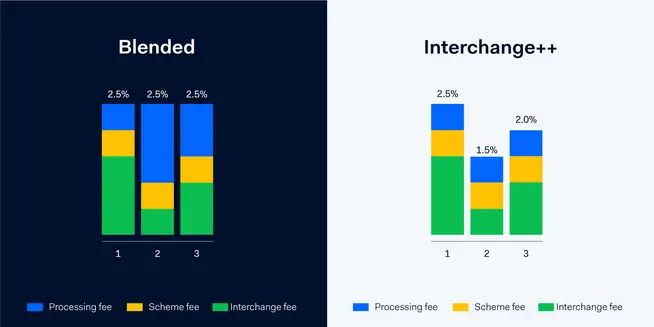
Interchange++ and Blended are the most used pricing models for card transactions. The main difference between them is transparency.
Interchange++
Transparent breakdown of all three fees: the acquirer markup, the card scheme fee, and the interchange fee
You pay actual interchange plus a markup
It can be cheaper over time
Savings from cost optimisation are passed through to you
Blended pricing
Fixed rate per transaction
Simpler, but less transparent
Savings from lower interchange fees are often hidden
Under a blended model, a provider can absorb any interchange savings you generate, whether from local acquiring, smart routing, or enhanced scheme data, into their fixed markup, and you'd have no way of seeing the benefit.
It's why we always bill using Interchange++. We only earn on the acquirer markup and any fees we've explicitly agreed with you. When we negotiate a lower interchange rate, route a transaction more efficiently, or you take steps that qualify for a cheaper rate, the saving passes through to you rather than being folded into what you already pay us.
Interchange fee regulation
Traditionally, there was very little transparency into how interchange fees were calculated. Large businesses with high transaction volumes could negotiate lower fees, while smaller firms had to pay the full amount.
Regulators and card networks have recently taken steps to standardise interchange fees by introducing stricter rules, fee caps, and greater transparency.
The following are regulations that shape global interchange fees.
European Interchange Fee Regulation (IFR)
The European Economic Area (EEA) introduced interchange fee regulations in 2015. This led to heavy interchange fee regulations, capping interchange fees for consumer cards across all countries in the EEA. As a result, the EEA is now one of the cheapest options worldwide and is considered an excellent place to set up entities for cross-border transactions.
Since the UK's withdrawal from the EU, the EEA fee caps no longer apply to transactions when a customer uses an EEA-issued card to pay at a merchant in the UK, or when they use a UK-issued card to pay at a merchant in the EEA.
The interregional caps apply to transactions at merchants located in the EEA and the UK. The EEA and UK interregional fee caps for card-present transactions are 0.20% for debit transactions and 0.30% for credit transactions. For card-not-present transactions, the fee caps are 1.15% for debit transactions and 1.50% for credit transactions.
US: The Durbin Amendment
The Durbin Amendment, introduced in 2010, caps debit card interchange fees for large banks and requires competition between card networks. Its goal is to lower payment processing costs for merchants.
The Durbin amendment is dependent on the size of the issuing bank's assets. If the issuing bank has assets of $10bn or more, its debit and prepaid cards will be charged regulated rates. These cards are then subject to an interchange rate of 0.05% + $0.21 or 0.05% + $0.22, depending on fraud prevention policies.
Key takeaways and how Adyen can help keep fees low
Interchange fees are the largest cost in card payments
They are regulated in Europe but market-driven elsewhere
You can optimise but not eliminate them
Choosing the right pricing model has a major impact
How Adyen helps you manage interchange costs
Local acquiring across major markets, so more of your transactions process domestically instead of at higher cross-border rates
Intelligent payment routing that selects the best-performing network for each transaction automatically
Enhanced scheme data built into the platform, helping eligible transactions qualify for lower rates without extra manual work
Interchange++ billing as standard, so savings from all of the above reach your bottom line rather than disappearing into a provider's markup
Ready to optimise your card program and maximise interchange revenue? Get in touch today to learn how your business can benefit.
Interchange fees FAQ
No. They are set by the card networks (like Visa and Mastercard) and are charged by the customer's bank (the issuer). These rates are non-negotiable and change periodically based on market regulations and network updates.
However, businesses can optimise their costs by using local acquiring to benefit from regional fee incentives or by implementing security tools like Address Verification Service (AVS) that can trigger lower interchange categories.