Article
The hidden cost of payments for remittance platforms
From liquidity gaps to authentication friction, remittance platforms face payment challenges standard providers can’t solve.

When your customer in London sends money home to Lahore, they expect the funds to land within minutes. That’s the promise you make to ensure trust and loyalty. But behind that promise sits a business problem: the card payment that funded the transfer may not settle into your account for several days. Until then, you’re the one covering the gap.
This is the daily reality for treasury and payments teams at remittance platforms. Money is moving constantly but margins are tight. You rely on high volumes which means staying competitive with instant transfers, even when you have to front the cost yourself.
Equally important is capturing new customers. Every card decline or failed security check is a potential lost customer.
Adyen works with a broad spectrum of remittance businesses including Western Union, Wise, and Taptap Send. Regardless of size, every remittance faces the same continuous challenge of balancing the customer experience with compliance and liquidity. This article unpacks three of these challenges, explains what to look for in a payments provider, and how Adyen can help.
Curious to learn how we can improve your liquidity with same-day payout and capture more customers with optimised payment acceptance? Get in touch.
3 challenges for remittance platforms: liquidity, payment acceptance, authentication
1. Your liquidity is under pressure every day
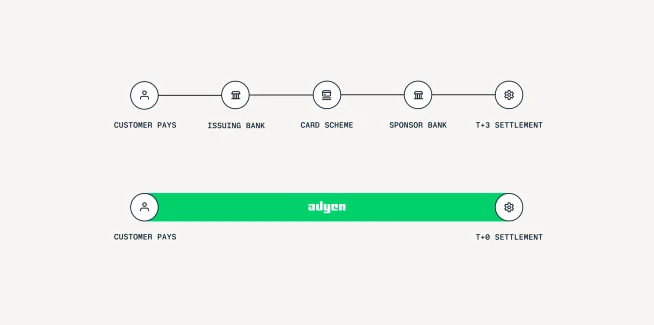
If someone’s transferring their hard-earned money internationally, they expect that transfer to be made instantly. The problem is that most payment providers can’t settle immediately. They rely on third-party banking intermediaries and have to wait for card schemes to settle funds before paying out to you. This can take several days.
To meet your customers' expectations, you're forced to prefund the transfer out of your own capital while you wait. This pressure on your liquidity intensifies around big cultural moments such as Eid, when thousands of customers send money on the same day. You need to have a lot of cash available to cover that spike.
The result is that your capital is tied up for days at a time, when it should be working hard for your business.
2. Payment decline rates are too high
Card declines break the customer journey at a crucial point, which makes the stakes higher for low-loyalty, low-margin, and highly-competitive verticals like remittance. Decline rates also tend to be higher in this vertical because customers may be immigrants using non-local identification documents, or transferring money between banking systems that don’t operate well together.
When one of these legitimate payments fail, you risk losing the customer before you’ve had the chance to recover the cost of acquiring them.
3. 3D Secure is a conversion problem
Outside of insufficient funds, 3D Secure checks are one of the biggest causes of declines for remittance platforms. Authentication mandates exist for a good reason, but a blanket approach can create unnecessary friction for legitimate customers.
Some customer groups feel this more than others. Working through a multi-factor authentication flow on a small screen isn’t straightforward, and many abandon the transfer mid-way. This is especially frustrating for repeat users making the same transfer every month.
Loyal customers should be rewarded with a faster experience, not treated like strangers every time.
What to look for in a payments provider
Not every payments provider is built for the realities of remittance. Here are some questions to consider when you're evaluating different vendors:
Do they offer fast settlement, even during peak seasons?
To protect your liquidity, you’ll want a provider that can settle funds into your account as soon as possible, ideally on the same day. It’s also worth checking they can maintain these speeds during peak periods such as Eid, Chinese New Year, or Christmas, when transfer volumes spike.
Can they help you recover payment declines?
A strong provider will know when and how to recover declines. That might mean retrying the payment through a different network or sharing additional data with the issuers. The result is that more legitimate payments are approved, often before the customer sees an issue.
Do they treat return customers like strangers?
Repeated payment authentication or manual entry of payment details disrupts the customer experience. To avoid this, look for a provider that can tell the difference between a first-time user and a customer who has sent money to the same recipient every month for the past two years.
This can be done by using tokenization as a way of securely storing card details for repeat transfers (which also automatically update if a card is lost, stolen, or expires). The provider should also use transaction history and device data to determine whether to apply authentication layers like 3D Secure.
Can they offer local processing in your key markets?
It doesn't matter how many regions a provider covers if they can't get your payments approved where you operate. Check their coverage map, and find out whether they can offer local processing through their own licenses or via partner connections.
How Adyen balances liquidity and customer experience
Adyen is a global financial technology platform with banking licenses across the US, UK, and Europe. We connect directly to card networks and local payment infrastructure in all key markets around the world. This removes the need for intermediaries allowing us to optimise every payment and settle funds fast.
We work with some of the world's biggest brands including Uber, Spotify, and eBay plus insurers, financial institutions, and remittance platforms. Here's what you can expect if you work with us:
Get same-day settlement, even during peak periods
Most payment providers must wait for card schemes to settle funds before they can pay out. Our banking license removes that dependency. We can advance a full day's net sales to you on a T+0 basis, regardless of whether the card schemes have settled those funds to us yet.
In the UK specifically, our license with the Bank of England, paired with a direct integration to the Faster Payments System, lets us complete transfers within minutes rather than days. That means you get a single consolidated settlement every day instead of fragmented payouts trickling in over time.
And we're no stranger to high volumes. Over the 2025 Black Friday, Cyber Monday weekend, we processed $43bn, peaking at 199,000 transactions per minute, while maintaining 99.9999% uptime throughout. You can be sure our platform won't falter when it matters.
Recover declines with our our conversion optimisation platform
A single decline can be enough to lose a customer for good. Our conversion optimisation platform, Adyen Uplift, works behind the scenes to recover transactions that would otherwise be lost. To improve authorisation rates still further, we replace card data with secure tokens. That’s why customers using Adyen Uplift saw an average 6% increase in their conversion rates.
Support fast one-click payments for recurring customers with tokenization
Repeated authentication and manual card entry creates friction for loyal customers. To avoid this, we use tokenization to store card details securely so returning customers never have to re-enter them. Meanwhile, we use transaction and device history from across our entire platform to apply 3D Secure selectively rather than by default. This means your loyal customers are rewarded with a fast experience rather than being treated like a stranger every time.
Discover how we helped Infold Games boost payment success rates by 12% with tokenization >
Process payments locally with global acquiring
When your organisation is based on the successful movement of money across borders, coverage alone isn’t enough. We hold local acquiring licenses across Europe, North America, Latin America, and Asia Pacific, so transactions in your key markets are processed locally rather than cross-border. That is what drives higher approval rates and lower costs in the markets that matter most to your business.
"Adyen helped us with local acquiring in the US, which had a positive effect not only on our top line but also on the bottom line. Through local acquiring, we were able to reduce our bank declines by 21%." Dennis Friemerding, Team Lead Payments, FlixBus
Choose a payment provider that can address payment acceptance and liquidity in one place
A standard payment service provider can process your transactions. But if it depends on the settlement times of third parties like card schemes and other payment methods, it can never fully solve the liquidity challenge behind those transactions.
When evaluating providers, look for one that owns the infrastructure needed to close the liquidity gap, recover declines, and authenticate customers based on who they actually are.
If you want to see what this looks like for your business specifically, get in touch with our team to talk through your global footprint, your volumes, and where the biggest opportunity is to free up working capital and protect your margins. Get in touch.