Article
Financial reconciliation explained: What you need to know
Accurate financial reconciliation is key for making informed business decisions.

Financial reconciliation plays a pivotal role in guaranteeing the accuracy of a business's financial records. When executed effectively, it becomes a powerful tool for saving time and resources, empowering businesses to make informed decisions.
Unfortunately, many businesses grapple with a challenging situation, often relying on outdated legacy infrastructure for financial reconciliation. This usually leads to an error-prone process that wastes time and resources. According to an Adyen study, businesses often have more than four full-time equivalent (FTEs) working with financial reconciliation. 36% of companies also lose at least one full workday per week on payment operations.
To overcome this challenge, businesses can embrace automated solutions, paving the way for a streamlined and error-free financial reconciliation.
In this blog post, you’ll discover:
What is financial reconciliation?
Why is financial reconciliation important?
Financial reconciliation benefits
Types of financial reconciliation
Financial reconciliation challenges and best practices
The benefits of a single financial technology platform
What is financial reconciliation?
Financial reconciliation is an accounting process where businesses compare two sets of financial data. The main goal is to ensure the information is correct and identify and resolve any discrepancies early on in the accounting process.
The financial reconciliation process
Financial reconciliation involves checking and matching internal records with external documents, such as invoices, receipts, and bank statements.
Businesses do reconciliation regularly to maintain the integrity of financial records and promptly address discrepancies.
Why is financial reconciliation important?
Financial reconciliation verifies the reliability of a business’s financial statement. Businesses do this to confirm that they are accurately credited for incoming revenue and that the outflow of funds aligns correctly with documented and acknowledged payments.

Financial reconciliation benefits
There are multiple reasons why financial reconciliation is beneficial for businesses:
Accurate financial records: When a business processes or records financial transactions, discrepancies and errors may happen. Reconciliation serves as a method to find these disparities and solve them.
Fraud detection: Financial reconciliation is a way to protect businesses from fraud. By comparing records, businesses can find discrepancies that may suggest a transaction was fraudulent.
Compliance with regulatory standards: Reconciliation helps businesses fulfill compliance and regulatory requirements. Accurate bank reconciliation enables businesses to adhere to auditing standards and generate financial statements that align with regulatory guidelines.
Decision making: Financial reconciliation helps businesses establish confidence in the accuracy of their information. This empowers them to make informed and strategic decisions based on a solid foundation of financial insights.
Types of financial reconciliation
Businesses do different types of reconciliation, like:
Payment reconciliation
Payment reconciliation is a financial process where businesses compare the payments made or received to what is recorded in the books and financial statements to ensure they match.
POS reconciliation
Point of sale (POS) reconciliation is similar to payment reconciliation, with the main difference being that POS reconciliation focuses on transactions from POS systems.
Intercompany reconciliation
Intercompany reconciliation compares and verifies financial transactions between companies owned by the same corporate group.
Inventory reconciliation
Inventory reconciliation is the process of comparing inventory data with what businesses have in stock.
Digital wallet reconciliation
Digital wallet reconciliation involves verifying digital wallet transactions to ensure that internal records align with statements from digital wallet providers.

Financial reconciliation challenges
Although financial reconciliation is essential, businesses often struggle with it. Many face challenges that make it a complex and cumbersome process. These challenges usually involve:
Legacy providers
Many businesses work with legacy providers who have different disconnected systems for online and in-store operations. This makes reconciliation challenging. Automating the process isn’t an option, as these providers often use legacy tech infrastructure and don’t offer the modern technology needed. Instead, businesses do it manually, which can take days due to all the disconnected systems. This often requires businesses to have specific teams that usually consist of more than four FTEs focusing only on financial reconciliation, resulting in high operating expenses and wasted time and resources.
Fragmented processes
An enterprise business often operates across regions, in multiple locations and with multiple payment service providers. The different acquiring banks and fragmented systems make consolidating the data and reconciling payments from different stores a challenging task.
If the central finance team needs to pull out a report for a specific region, they need to manually download reports from each country and combine them. Sometimes it takes days for local teams to send these reports.
Another challenge is that reconciliation teams get different formats across different payment methods. Adding everything in a single format is cumbersome.
High overhead and errors
Since reconciliation is mostly manual, there’s a higher risk of human errors, leading to teams spending time troubleshooting and fixing issues. Human errors in reconciliation may also result in non-compliance, leading to penalties or legal consequences.
Businesses performing manual reconciliation also lose valuable time, resources, and money. Over 30% of organisations see errors from manual processes as a primary financial reconciliation challenge.
Financial reconciliation best practices
The best way to do financial reconciliation is to automate the process. In that way, businesses save time and resources and focus on what’s important for their business. Following are some of the benefits of automated financial reconciliation:
Streamline the process: All data from all operations and channels are consolidated in one system, minimising overhead and time invested. This also results in more timely and accurate financial reporting.
Centralise the view: Comprehensive reconciliation services are provided in one central location in one single format.
Minimise human errors: Implement automated reconciliation to eliminate human errors in manual entries and streamline the retrieval of multiple data sources.
Businesses need financial reconciliation software that can offer modern technology to automate the process. In the next three years, 66% of financial services organisations plan to heavily invest in new solutions automating manual processes, considering it a top-three priority.
The benefits of a single financial technology platform for reconciliation
As new technology emerges, increasing financial reconciliation efficiency becomes easier than ever. Businesses can seize this opportunity by turning financial reconciliation into an efficient process that saves time, effort, and resources so that they can focus on other core business initiatives that drive more value.
With our unified reporting portal, Adyen enables you to reconcile and settle transactions seamlessly across diverse payment methods and channels, all in one place and in a standardised format.
"Adyen's settlement features help HUGO BOSS establish rock solid and lean accounting processes, regardless of the payment method or channel the transaction happened."
Boris Griesinger
Head of Finance Operations, HUGO BOSS
Discover more about how HUGO BOSS enhanced operational efficiency.
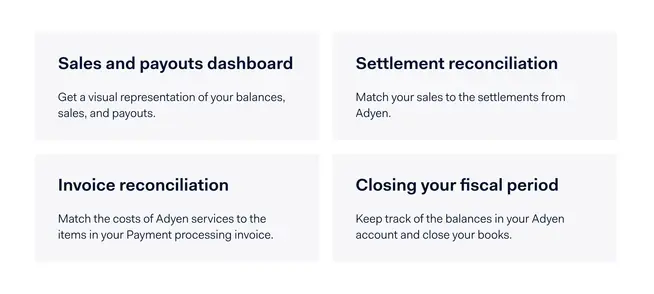
With Adyen, you get a single platform to streamline operations and ensure all reconciliation is managed in one place. This includes:
Real-time, automated reconciliation
Resource-efficient reconciliation
Merchants have reduced the FTEs working on reconciliation from four to one after adopting Adyen's modern solution. Your team saves days on financial reconciliation and can instead focus on enhancing customer experiences and driving business growth.
Want to take the next step in your journey to reducing financial reconciliation from days to hours? Get in touch.
Financial reconciliation for different industries
Improving financial reconciliation efficiency in retail
For large or omnichannel retailers, financial reconciliation can be a complex and time-consuming task, especially when data is fragmented across multiple systems.
Finance teams often spend significant time matching each line item from the point-of-sale (POS) system to settlement data and resolving any discrepancies that arise. Whether due to failed payments, refunds, or chargebacks, these discrepancies must be flagged and investigated. This ensures accuracy, but it involves a great deal of manual work.
Manual reconciliation also increases the risk of errors. To solve this, retailers are turning to unified payment platforms, where processing, acquiring, and reporting all happen in one place.
With end-to-end visibility and automated reporting, reconciliation becomes faster, more accurate, and far less stressful.
Simplifying night audit for hospitality
When it comes to financial reconciliation, hospitality businesses often face fragmented processes, managing payments across multiple systems such as PMS, POS, and booking engines, each with different providers, reports, and timelines.
With this setup, a hotel management group operating multiple brands under one umbrella may struggle to consolidate reporting across properties.
Similarly, a franchise hotel might use different PSP for different locations, making settlement more complex. This leads to manual work, delayed reporting, and mismatches in guest billing.
Hospitality businesses also often struggle to align the sales day closing time with the night audit. For example, a hotel restaurant might close at 12 a.m. on Thursdays but at 2 a.m. on Fridays. However, due to lack of flexibility, hotels may be unable to adjust the sales day closing time accordingly. As a result, purchases made after midnight on Friday appear on Saturday’s receipts, causing reporting inconsistencies.
The ideal scenario for hospitality is a unified view of all payments, by guest, brand, or property, with automated reconciliation and centralized reporting. This allows hospitality businesses to simplify processes like night audit by using dynamic sales day to define when their sales day should end on different days. Hospitality businesses that work with Adyen have decreased time spent on night audit from 40 minutes to 10-20 minutes.
Financial reconciliation with Adyen
With our unified reporting portal, Adyen enables businesses to reconcile and settle transactions seamlessly across diverse payment methods and channels, all in one place and in a standardized format.
For hotels this means all payment touchpoints across the hotel experience are connected through a single platform—streamlining operations, simplifying night audit, supporting dynamic sales days, and providing finance teams with a single source of truth.
For retailers, this reduces the burden on finance teams. With Adyen, they can automate the reconciliation process, increasing accuracy, reducing risk of errors and freeing up employee resources.
"Adyen's settlement features help HUGO BOSS establish rock solid and lean accounting processes, regardless of the payment method or channel the transaction happened."
Boris Griesinger
Head of Finance Operations, HUGO BOSS
Discover more about how HUGO BOSS enhanced operational efficiency.
With Adyen, you get a single platform to streamline operations and ensure all reconciliation is managed in one place. This includes:
Real-time, automated reconciliation
Resource-efficient reconciliation
Merchants have reduced the FTEs working on reconciliation from four to one after adopting Adyen's modern solution. Your team saves days on financial reconciliation and can instead focus on enhancing customer experiences and driving business growth.
Want to take the next step in your journey to reducing financial reconciliation from days to hours? Get in touch.