Australian Digital Report 2024
Unlocking potential: Driving business growth with payments optimisation

This report combines insights from commissioned consumer and business research to uncover how digital enterprises can strike the right balance between cost and conversions.
Consumers
businesses
Markets
The complex path to sustainable growth
"Driving payment optimisation is very much top of mind for digital businesses," says Trevor Nies, Global Head of Digital at Adyen. The path to sustainable profitability grows more complex as digital businesses navigate the uncertain macroeconomic climate. This is supported by our research – 31% of digital enterprises in Australia say that one of their most significant challenges is the effect of high inflation on their customers.
More than ever, businesses in Australia are focused on protecting their bottom line by boosting sales conversion and revenue. In fact, over half (54%) of the online enterprises surveyed say they are focused on increasing revenue in 2024 as compared to last year, while 37% are focused on reducing costs.
In addition to the challenging global economy, digital enterprises must adapt to emerging technologies and evolving customer expectations. These expectations differ based on culture, industry, age, and location. The currency of culture is vital – how consumers make online payments is cultural and differs from market to market.
While most consumers still prefer to make online payments with credit cards, the relevance of local payment methods is growing rapidly worldwide. In Asia, for instance, digital wallets like Apple Pay and Google Wallet see the highest adoption in markets like Malaysia (58%), Hong Kong (51%), while only 26% of consumers in the US prefer digital wallets. Buy Now, Pay Later is also enjoying its time in the spotlight, gaining popularity in European markets like Norway (38%) and Sweden (34%), surpassing Australia at 19%. Lastly, Pay by Bank is also a rising local payment method in markets like Brazil (41%) and Hong Kong (22%) compared to just 3% in Australia.
Lastly, how can businesses keep up to date with the ever-evolving industry as digital transformation sweeps across different industries? The key is to shift perspective – digital enterprises need to leverage payments strategically as a revenue driver to gain an edge in a highly competitive industry.
Digital enterprises must optimise their payments and balance cost and conversion to stay ahead.
Key findings
of digital businesses are planning to invest in a subscription model this year
of digital businesses are looking to expand to new markets
of digital enterprises are looking at data-rich payments insights to uncover new growth areas for their business
of consumers are deterred from making a purchase if their preferred payment option is unavailable
Unlock profit potential
The value of payments
The overall value of payments goes beyond just saving costs. Optimising payments represents an opportunity for significant returns where small changes can ladder up to significant business value for digital enterprises. While 40% of digital businesses are looking to lower the cost of payments, it's crucial to strengthen your payments setup to boost your customer experiences and scale with operational efficiencies at the same time. Together, these three key objectives contribute to crucial gains that can help you unlock profit potential for your business.
Keeping up with the evolving digital industry means considering the value that payments optimisation can bring; businesses that don’t consider the value of payments optimisation are at risk of falling behind.

The subscription must go on
As the subscription model continues to flourish, over two thirds (69%) of Australian businesses want to invest in one in the year ahead. Recurring payments are convenient and seamless for customers, who "set it and forget it" with a credit card or local payment method. Still, 40% of Australian consumers have already or plan to reduce their online subscriptions.
With subscription plans a dime a dozen, how can you cut through the noise to reach your customers? It's crucial to pick the right payment processor or platform that will help reduce technical issues (e.g., compliance, subscription churn, and fraud) that impact the billing process. Make recurring payments effortless, seamless, and sustainable with Adyen. Find out more >

"The subscription market is projected to grow globally from $690 billion in 2024 to over $900 billion by 2028. As this segment expands, end customers are demanding more flexible subscription options, leading to increasingly complex models. Combined with global regulations, revenue recognition challenges, and required retention strategies, businesses need to invest in the right partner to enable deeper penetration into existing markets, allow global expansion, and reduce churn."
Build superior customer journeys to increase conversion
From offering the relevant local payment methods to creating seamless customer authentication flows, optimising your payments setup has both incremental and long-term benefits for your customer experience and conversion rate. In fact, 45% of consumers want digital businesses to offer their preferred payment methods, and 34% seek effortless payment authentication without redirects.

The sweet spot: optimise your payment method mix
Offering a range of up-to-date payment options that reflect local preferences is the key to a smooth payments experience and an increase in conversion. In fact, 81% of consumers surveyed will be deterred from making a purchase if their preferred payment method is not available online, and 51% will abandon their cart altogether.
When choosing the appropriate mix of payment methods, these are the three factors to consider:
Geography – where are your customers located?
Demography – what age range do your customers fall in?
Context of the purchase – what are you selling?

Quick transactions and quick wins
Another way to create a better online payments experience and boost conversion is by offering Click to Pay. This type of express flow lets customers pay with only a few clicks. Express flows do this by storing payment details securely, meaning customers don’t have to fill out their details for each purchase.
Express flows are particularly useful for guest checkouts, where a customer has not set up an account with a digital business, as this solution means that they don't have to enter their details to complete their transactions.
And the consumer interest is there: 21% want online businesses to provide an option to remember their details for next time, while 29% want guest checkouts.
Seamless checkout experience
The moment your customer lands on your checkout page is the culmination of your hard work. Here, they will enter their payment details before completing the purchase. But you still need to close the sale.
The good news is that businesses can create a mobile-optimised and secure checkout in minutes, with just a few lines of code. An optimised checkout page delivers a superior payment experience, boosting your sales conversion. With Adyen, one backend integration offers multiple implementation options that enable your business to create experiences tailored to the expectations and needs of each customer.
A smooth authentication engine
Security remains at the top of many consumers' minds. Just under half (48%) use biometrics, specifically fingerprint or facial recognition, to authenticate online transactions. Markets across the world, like Europe, India, Australia, and Japan, are also introducing regulations that mandate the use of authentication.
The key for online businesses is to balance convenience and security by offering the best authentication experiences. By leveraging payments innovation, businesses can now detect and prevent fraud faster and reduce its negative impact with smart authentication.
Some authentication processes create unwanted friction in the checkout flow, like multiple web page openings, timeouts, and additional logins. More sophisticated products verify consumers only when necessary. Since many businesses on our global platform block more than 5% of revenue with their risk management systems, many of the false-positive transactions could be saved through optimising the use of 3DS flows. Risk-based authentication leverages effortless authentication flows to do just that.
Customer trust is a solid reason to get it right: 34% of customers want online businesses to ensure effortless payment authentication without redirects. In markets with mandated authentication regulations, online businesses need to balance creating frictionless payment authentication flows while staying compliant. On the other hand, in markets without mandated regulations, enterprises can leverage authentication as a tool to reduce fraud and boost payments security.
Leverage relevant payments data from Adyen to optimise the authentication process. Learn how to make authentication easy for your customers here.
Scale with revenue optimisation
Optimising your payments setup improves customer experiences and boosts sales. Combined with AI and automation, the benefits to your revenue are manifold.
"In a traditional payment setup, we see that using our full-stack solution helps save on average 2% of payments, which on a large number of transactions is a huge additional revenue," says Amber Bienfait, Strategy Planning and Execution Lead at Adyen.
One way to scale with revenue optimisation is through recovering declined payments. It's not a blame game when it comes to payment declines – there are a multitude of reasons why payments can be declined. Here are some of the most common ones:
Insufficient funds: One of the most common reasons for a payment decline. This happens when a customer doesn't have enough funds in their account to complete the transaction
Technical issues: Shoppers don't see errors between the card schemes and issuers. These tend to lead to "technical error" messages. On the backend, the payment form can also time out, causing the customer to drop out of the payment flow.
Wrongly formatted messaging: Each issuing bank has different risk preferences and technologies, and these preferences extend to messaging. For example, CVC or expiry date data can be formatted differently depending on the issuing bank.
Recovering payments smartly
Recovering payments can take up considerable operational resources, but doesn’t have to be such a manual process. RevenueAccelerate is Adyen's revenue optimisation product suite that lets businesses increase revenue with AI and Smart Logic.
Two specific solutions under RevenueAccelerate help your business recover declined payments the smart way: Auto retries and Auto Rescue.
Auto retries: This feature automatically retries declined transactions within milliseconds to minimise declines due to technical errors or outages. We do this through the same or a secondary connection, using our platform data to retry only when there’s a high chance of success. Each successful automatic retry prevents your business from incurring extra card network fees. With AI, we can even find out how best to format them and when not to retry at all. This solution can rescue up to 80% of failed transactions on the first attempt, maximising your business’s conversion rate.
Auto Rescue: This solution uses Smart Logic based on our wide range of payments data to retry failed transactions with a chance of succeeding. It performs retries at optimal times on behalf of your online business. Unlike Auto retries, Auto Rescue reattempts the payment at a later time or date, making it ideal for subscription businesses.

“Since moving to Adyen, while scaling in new markets, Cover Genius has recorded the highest authorisation rates amongst all of our previous payment suppliers, and our chargebacks have significantly decreased.”
Simplify global complexities

Navigating the fragmented payments ecosystem
Behind-the-scenes of many transactions lies a fragmented payment ecosystem with multiple parties involved throughout. Navigating this fragmented payment ecosystem creates complexity, costing your digital business effort, time, and money.
One of the complexities is the sheer number of payment service providers (PSPs) available. The saturated market makes it difficult to choose the best payment service providers to work with and many digital businesses work with multiple PSPs at the same time. Over a quarter (29%) are looking to reduce the number of payment service providers they use to improve the efficiency of their payment operations. Around 42% of these companies currently work with four to seven providers. With so many partners, it's not surprising that 35% of online businesses find the reconciliation process complex.
Working with an all-in-one financial technology platform like Adyen reduces the complexity of navigating the fragmented payments ecosystem. We provide end-to-end payments, data, and financial management in a single solution. With our global platform, you won't need to juggle multiple contracts and prices, but manage reporting and reconciliation for all your transactions with just a single integration.
Additionally, you can settle when you want in the currency you prefer thanks to our direct connections to payment schemes and banking networks. Acquired payments can be settled daily, hourly, or instantly, removing unnecessary delays and third parties from the money flow, and supporting greater operational efficiency. We also hold banking licenses in the EU, UK, and the US to help support greater operational efficiency. Our banking licenses enable us to take care of settlement, instead of relying on banks, enabling us to provide faster settlement times, more automation and greater stability.
Unravel scheme and interchange fees
Scheme and interchange fees lie at the core of online payment costs. Making small changes here can add to greater business value. Enter Adyen's "Interchange++" pricing model. It's more transparent than other pricing setups. Your business will always know exactly what you're paying for and how much it costs. Any savings from changes in scheme and interchange fees will also be passed directly to you.

Expand globally with local expertise
Most digital businesses (56%) in Australia plan to expand to new markets, with New Zealand, the US and Japan being the top three target markets.
Global expansion: Where to, next?

A local touch is critical for digital businesses looking to accept online payments globally. Payments processed using local acquiring often cost less and are more likely to be authorised. Win-win. While digital businesses can get the most out of each transaction with local payment processing, only 27% are investing in working with local acquirers to lower transaction costs.
That’s where Adyen comes in. To lower transaction costs, Adyen can help businesses by identifying more cost-efficient alternatives, like local payment methods, to costly cross-border transactions. This helps businesses get the most bang for their buck, or most value out of their payments setup.
Additionally, with local acquiring integrated to a single platform like Adyen, it’s easy to unlock additional local payment methods – as easy as flipping a switch in Adyen’s dashboard. Additionally, payments data can be viewed across all regions and channels in one place, reducing complexities and boosting operational efficiencies. This allows your business to easily track payment methods and performance, spot trends, and get to know your most loyal customers.
Reduce compliance and certification costs of global expansion
Navigating the payments ecosystem gets even more complicated on a global scale. 20% of digital businesses find that navigating regulatory requirements in different markets is one of the most significant hurdles they face. It can be a challenge to deal with the laws, schemes, and complexity of global payment processing, while trying to optimise your payments systems simultaneously.
Working with a global financial technology platform is vital to reduce the compliance and certification costs of international expansion. Not only can digital enterprises significantly reduce the costs of international expansion, they can also seamlessly offer all relevant card connections and local payment methods worldwide. This helps businesses decrease global complexity, increase conversion rates, and reduce processing costs.
Wherever you're doing business
Adyen's there, too. Get the most out of our global acquiring platform, which is equipped with global banking infrastructure and local licenses. Partner with us to simplify complex local regulations as we provide guidance on regulations like Payment Services Directive 2 (PSD2) and Payment Services Directive 3 (PSD3) while ensuring that your business can accept online payments anywhere in the world.

"Adyen helps us with local acquiring in the US, which has a positive effect not only on our top line but also on our bottom line. Through local acquiring, we reduced our bank declines by 21%."
Go beyond payments processing
Zoom in on strategic growth
With digital transformation sweeping across industries, the online economy is growing and evolving exponentially. Online businesses must remain adaptable to changes, while focusing on strategic growth by working with innovative partners.
The value of partnering with the right financial technology platform goes beyond just payments. A platform that combines payments, data-rich insights, customer loyalty, risk management, and banking infrastructure is the key to unlocking a subscription to innovation and growth for enterprise businesses. Businesses are beginning to understand the need to go beyond payments processing. Over three-quarters (79%) of Australian enterprises agree that payments data supports how they streamline business processes, and 81% believe that it can help them offer new services and solutions their customers seek.

The enterprises that embrace the changes and need to invest in innovative partnerships stand to gain the most from them and put their best foot forward in an ever-evolving industry.

"Leveraging payments data reveals actionable insights into customer behavior and preferences, allowing businesses to anticipate trends, personalise interactions, and optimise their strategies. This proactive approach not only drives innovation but also enhances resilience and adaptability in a rapidly evolving market landscape."
Build customer loyalty
Online businesses can leverage payments data to boost loyalty through more personalised, relevant, and secure experiences. Customers demand convenience and a more customised shopping experience with the brands they love and trust. Indeed, 41% of Australian consumers want more personalised discounts to encourage them to stay loyal to businesses.
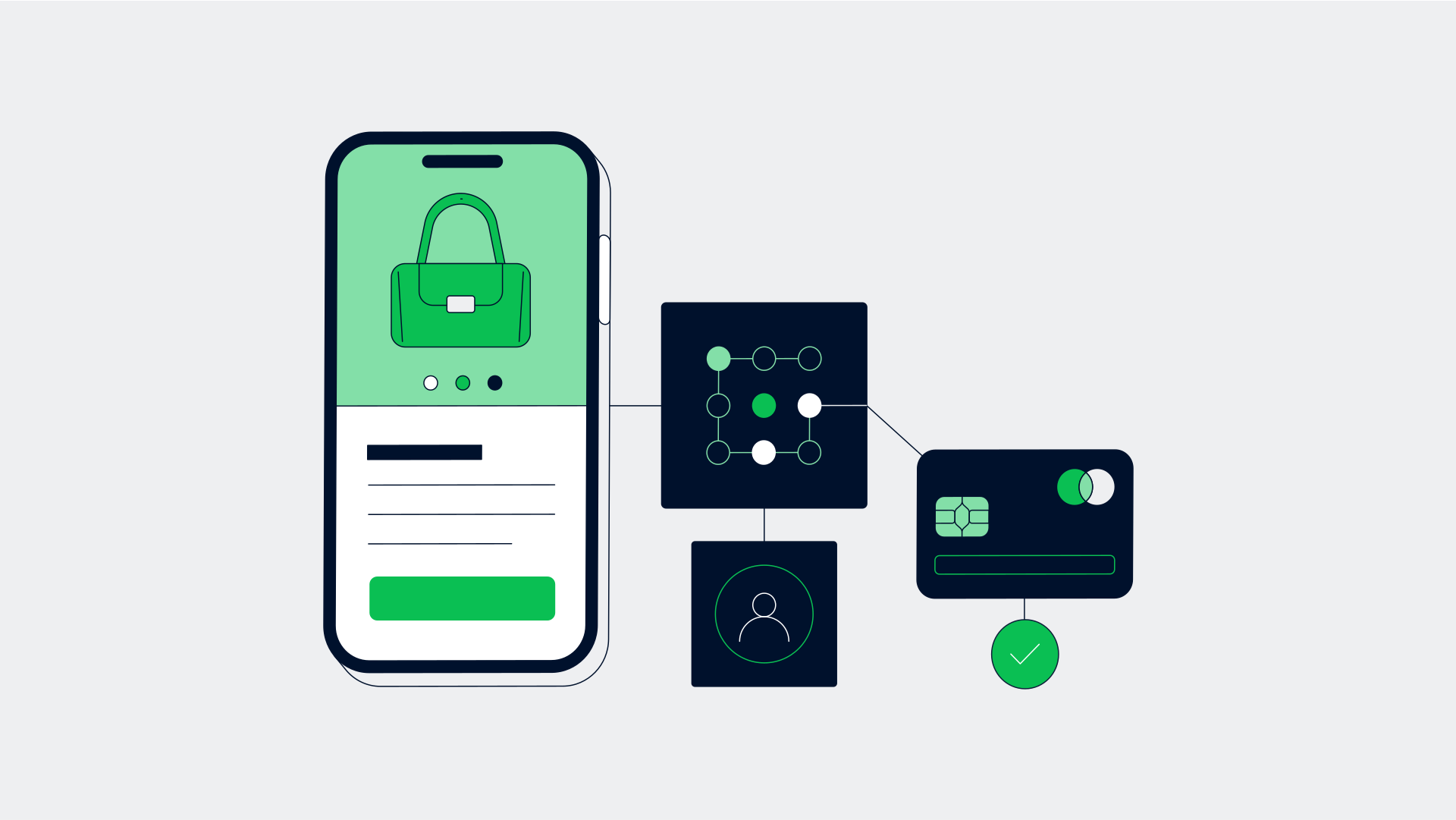
Payments data can help with creating a 360-degree business overview based on your customers' payment histories. This overview helps reveal customers' needs, wishes, and preferences, allowing you to boost customer experience, build loyalty, welcome new audiences, and grow revenue. From optimising online promotions and loyalty programs to improving personalisation and adapting to suit consumers' expectations in a new market, payments data can play a vital role in strategic decision-making.
Some digital businesses are already on the right track – 43% of them are working with payments data to better understand their customers. Plus, 33% are also investing in a loyalty program. It's crucial to leverage payments data and build customer loyalty; online brands that are not doing so risk falling behind.
Combat Fraud
Payments fraud is widespread, with 56% of Australian online businesses saying that payment fraud and chargebacks pose a significant cost. While payments fraud happens in stores and over the phone, online payment fraud is the most prevalent and fastest-growing. Technological advancements have aided the increase in payments fraud. For example, one-click payments make it harder for banks to detect and block fraud, while the dark web helps fraudsters cheat the system at a bigger scale. Online enterprises lose an average of AUD$2,133,042 to fraud every year, and 29% say that their fraud rate has increased between 2023 and 2024. Fortunately, just under half of digital businesses (49%) say that their fraud rate has decreased over the same period of time. This indicates that the risk management strategies employed by many digital enterprises have been effective in reducing fraud. However, as technology continues to advance, fraudsters are developing increasingly sophisticated methods to cheat the system.
Strike a sustainable balance between risk and revenue
Every business is different, and risk management needs to be tailored to your unique challenges. Here are our tips on striking the right balance between risk and revenue through detecting, preventing, and responding to fraud.
Detect: Recognise genuine customers and spot fraudsters across all your sales channels via fraud-detection technology that uses historical and cross-platform data between businesses to detect abnormalities, which can be further configured for specific high-risk industry segments or geographic regions.
At the point of payment, businesses can ask first-time customers for their details for future purchases, which they can authenticate with a password, CVV, or biometric authentication methods, allowing the brand to recognise them in the future.
Prevent: Combine risk rules with machine learning to maintain complete control and reduce operational workload. Use customised risk rules for your business needs, verify that a customer is genuine using 3DS2, and manually review high-value transactions.
Respond: Increase your authorisation rates and reduce chargebacks by adapting and optimising your risk setup, and test which risk management approach works best for your business.
The opportunities for fraudsters to commit payments fraud will only continue to rise as digital transformation sweeps across different industries. This means enterprises must provide better and more secure customer experiences and payment flows. RevenueProtect is Adyen's unique risk management solution with a range of tools to detect, prevent, and respond to fraud.
We use extensive payments and enriched shopper data combined with the power of machine learning to make the best risk decisions accurately, stay on top of the latest risk trends, and fight fraud effectively. With Adyen’s single platform solution, we are able to leverage insightful data to protect our customers from fraud. For example, we check the email address of shoppers against our comprehensive shopper data and have reduced false positive rates by 40%.

“We are excited to continue to unlock the power of delivering world-class payments globally in partnership with industry-leading companies like Adyen.”
Conclusion
Strike while the iron's hot
Our research highlights the increasing need for digital enterprises to optimise their payments operations in 2024 while striking the right balance between cost and conversions to stay ahead. Payments, when optimised right, becomes a revenue driver instead of a cost center. Businesses must partner with the right fintech platform to keep up to date with the latest payments and financial innovations, and make payments a crucial element in their growth strategies, giving these online businesses an edge in a very competitive and saturated market.
Adyen's robust, all-in-one platform empowers digital enterprises to navigate the most complicated challenges of 2024: unlocking profits, simplifying global complexities, and going beyond payments processing.
We're proud to be working with leading digital businesses like eBay, Uber, Spotify, Alibaba, Microsoft, Meta, Kogan.com and Cover Genius.
Discover seamless payments with the fintech platform built for digital businesses >
Methodology The Adyen Index: Digital Report explores global and local trends impacting businesses around the world. This report combines business and consumer data across 24 markets, coupled with economic commentary.
Business Insights Censuswide polled 8,822 senior leaders in digital businesses across Australia, China, Hong Kong, Japan, Malaysia, Singapore, Belgium, Denmark, France, Germany, Ireland, Italy, Netherlands, Norway, Poland, Sweden, the UAE, the UK, Brazil, Mexico, Canada, and the USA. Research conducted: 31 May - 19 June 2024.
Consumer Insights Censuswide polled 34,371 consumers in Australia, Hong Kong, India, Japan, Malaysia, Singapore, Belgium, Denmark, France, Germany, Ireland, Italy, Netherlands, Norway, Poland, Sweden, UAE, UK, Brazil, Mexico, Canada, and the USA. Censuswide polled a nationally representative sample size across each market. Research conducted: 03 June - 19 June 2024.